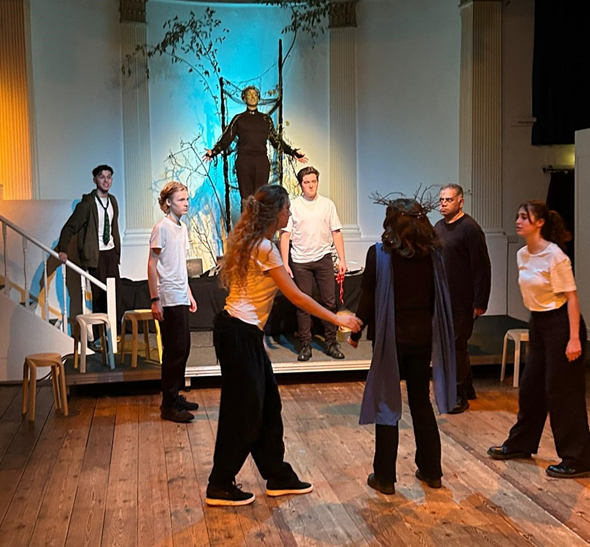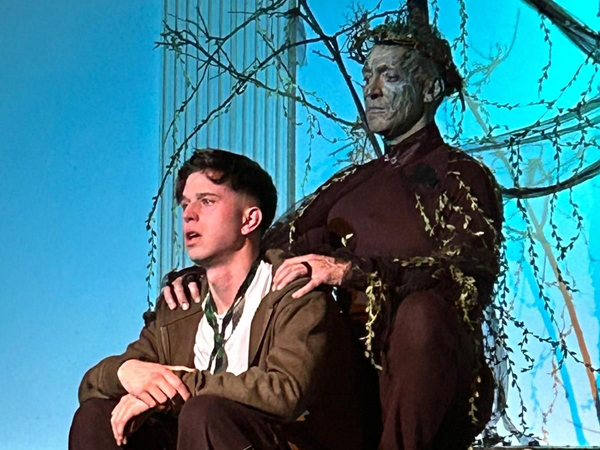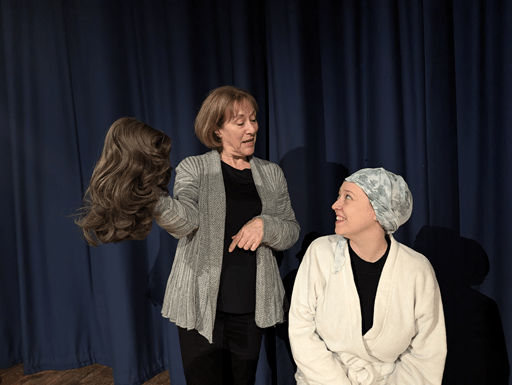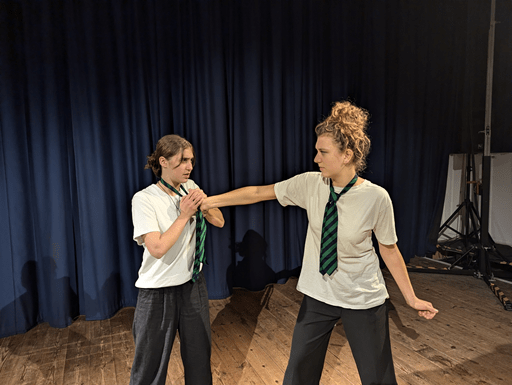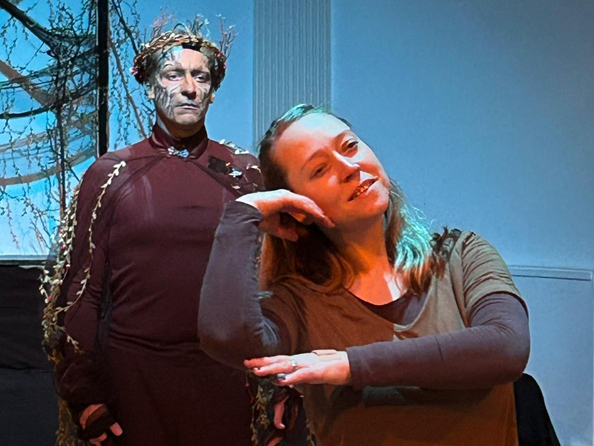
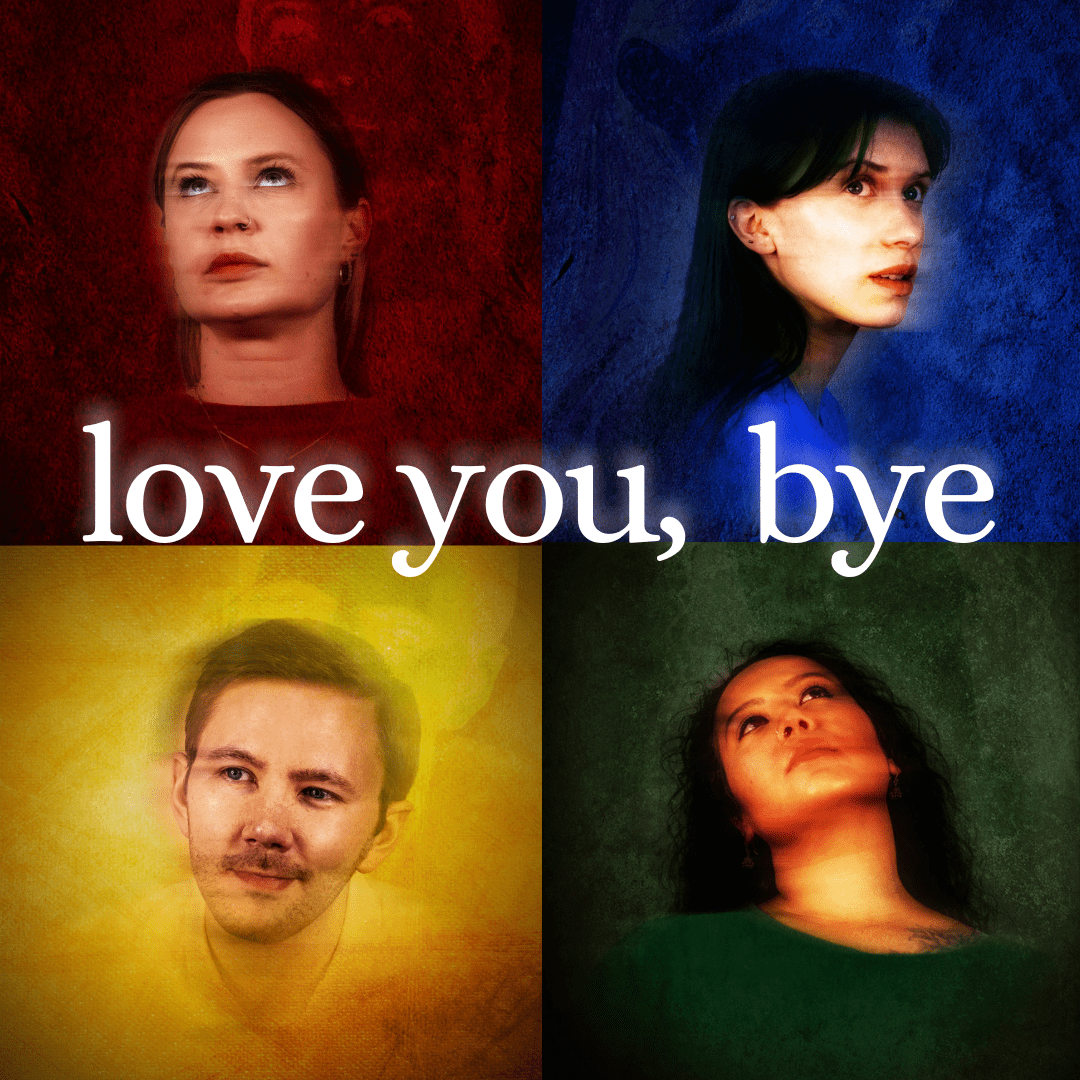
“love you, bye” at Ustinov Studio, Bath, July 7th-10th 2025.

By Ian Diddams
Images by Luke Ashley Tame of Acadia Creative

Around 2 million women are victims of violence perpetrated by men every year, that’s 3,000 offences recorded every single day.

A year ago, Uncaged Theatre brought their work in progress production “Faith” to the Rondo Theatre. Its review can be found here. A year later they are about to take its completed version – now entitled “love you, bye” – to the Edinburgh Fringe and are warming up with a four-night run at Ustinov Studio, Bath. It has indeed come a long way since that nascent concept and has become a more rounded, holistic production …  which is still sphincter clenchingly, seat squirmingly uncomfortable watching at times – especially if you are male.

The number of offences has grown 37% in the last five years and violence against women and girls accounts for 20% of all recorded crime. That’s recorded. Not total, only what is actually told to the police.  

The fundamental premise and action of the play remains the same – four friends, a missing woman, the ramifications. The external pressures on the group of trial by social media and finger pointing, and on the missing woman of asking for it, being out alone after dark. The media’s gloss-over reporting with its own inherent racial and societal biases, the group’s individual coping mechanisms, personal even selfish concerns…  and collapse of trust…  all remain in this final product. But while “Faith” was a work in full, “love you, bye” uses the play as a glorified MacGuffin to the real message of the production.
A woman is killed by a man every three days in the UK. That’s 168 women murdered at the hands of a man every year.

As writer Meg Pickup – who plays Colly – says “We didn’t want to write a play just about the victim – we wanted to write about those still standing, and how they carry the weight. We wanted to create something that doesn’t just speak to grief, but to the fierce loyalty and messy beauty of a chosen family. The group at the centre of the play acts as a microcosm of society’s response to violence against women and girls.”

In the year ending March 2022, there were 194,683 sexual offences, of which 70,330 were rape. Thats reported rape, again not total, only what is actually told to the police.

Is the performance a lecture? Is it “entertainment”? These are the questions asked by Colly/Meg directly to the audience. The characters reflect people we all know. Some reading this review and seeing the production will have shared in the characters’ own experiences. It uses real audio of the likes of Trump, Marilyn Manson, Andrew Tate interspersed with real voicemails of ordinary people wishing each other well, saying “I love you”, saying “’bye”. The social imagery is stark, uncomfortable. How do we as a society that individually expresses love to partners and friends combine to create monsters that prey on the vulnerable? Why is it those that are in positions of authority to protect, instead abuse that position. We all know these cases – and also not those cases that the selective media with its own biases omits from our newsfeeds.
Only 3.2% of reported rape is even prosecuted. Then of that 3.2% only 62% are convicted.

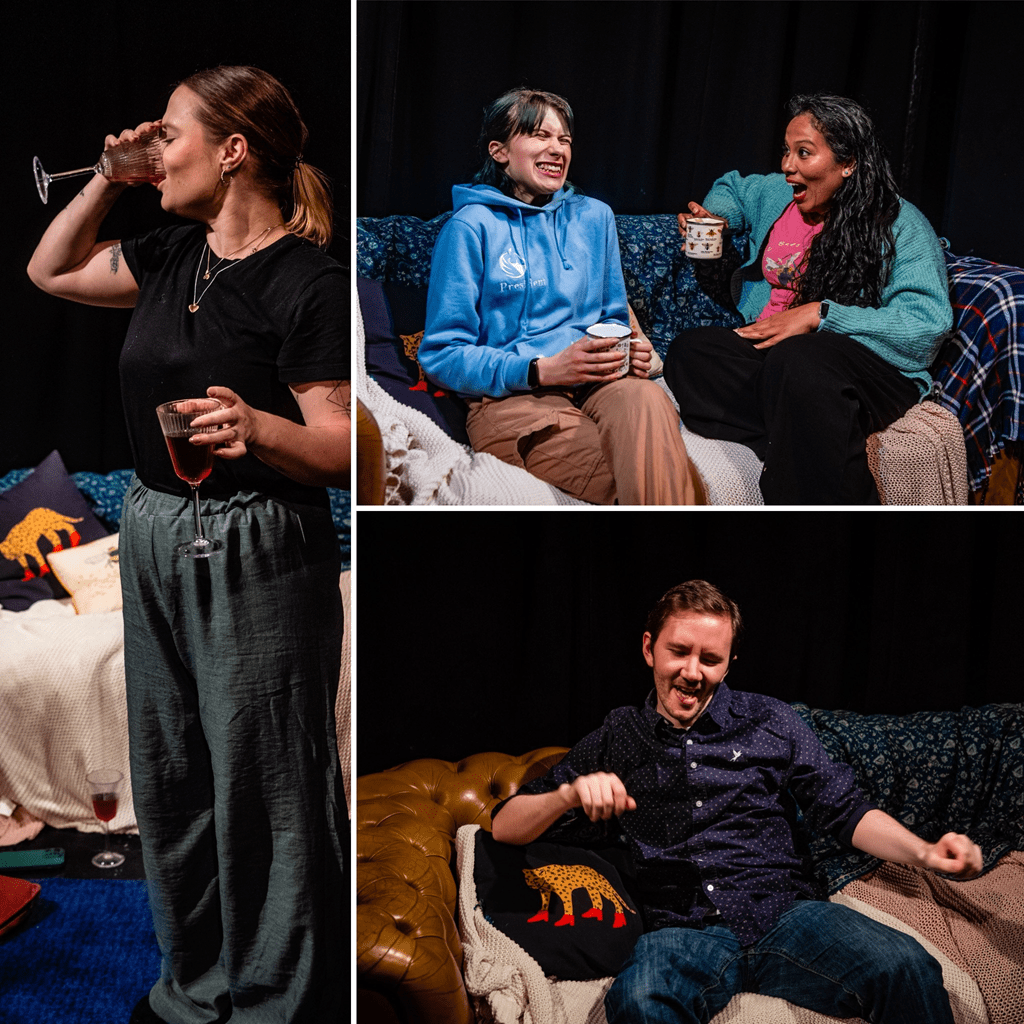
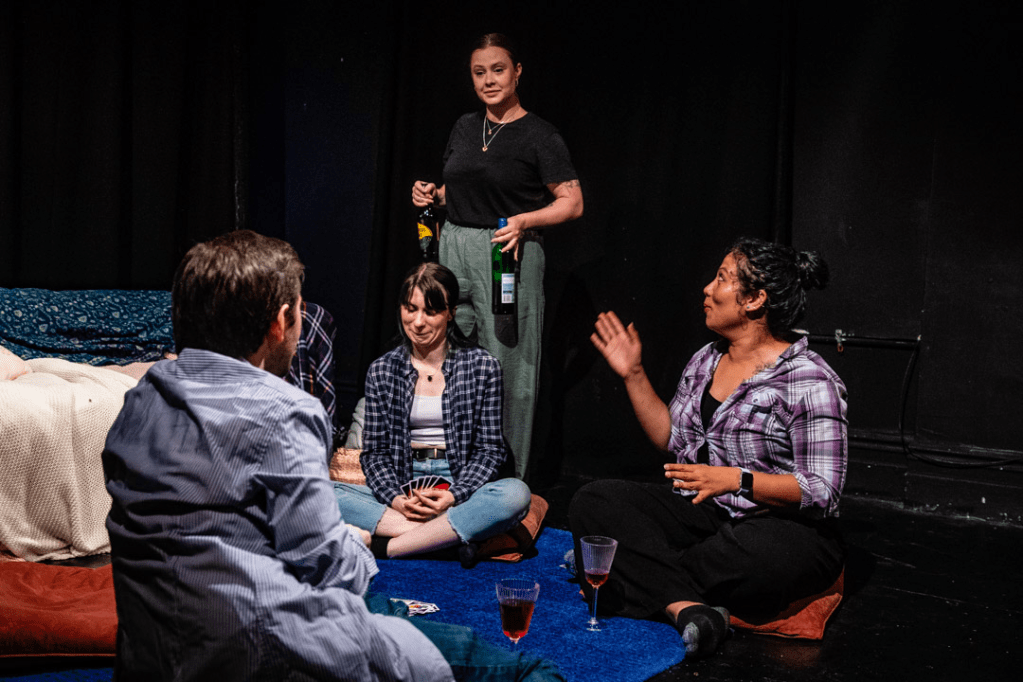
The play part of the production includes two new characters from “Faith”. Firstly, a collective female character “Everywoman” who is represented by the three female protagonists in their drinking game of “Never Have I Ever” requiring a downed shot for every challenge that has happened to them which quickly becomes increasingly dark outlining their shared experiences of violence as females. And there is now “Not-All-Men” –  a, it must be said, loathsome character insisting that it’s all somewhat overblown and not widespread, and whose own words condemn himself for his self denial and lack of collective responsibility and empathy, while wallowing in the words of Richard III and King Lear to justify his position.

The broad indication is that, during the last year, of the 70,330 rapes reported to police only 1,378 led to a conviction…

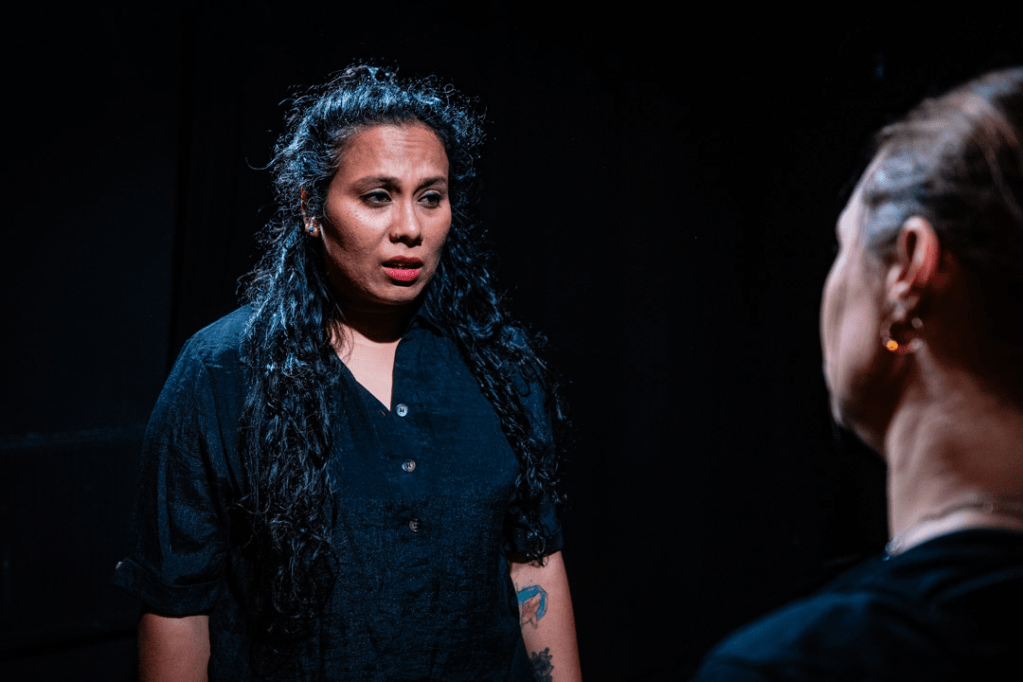
“love you, bye” is performed by four actors with six parts. Meg Pickup – who also co-wrote the piece – excels as the bullish and frankly bullying Colly who in some ways actually – unbeknownst to her – reflects some of the toxically masculine traits she so despises, in her relationship with Kaia, played by Taruna Nalini. Both portray their failing relationship with skill, neither overegging the tragedy that is happening to them externally and internally nor shying away from the difficult concepts of the story. Taruna’s vulnerability is the perfect foil to Meg’s bullishness and in so doing they reflect the wider society the premise of the play explores. Taruna combines the pain and pleasure of a relationship that isn’t always equal, while carrying a secret from her youth in a different culture, different social mores that nonetheless has a profound lifelong effect – her ability as an actress to mix these emotions and repressed fears is masterful. Billie-Jo Rainbird plays the pivotal role of Mercy, slightly on the outside of her friendship group but devoted to them all and they to her. Her strength is subtle, not worn on her sleeve but she is clearly supportive of not only her friends but also her partner’s anxiety back at their flat, all played sweetly and calmly, a unifying force. Billie-Jo also designed the sound and lighting for the show as well as the digital program. These three also represent collectively “Everywoman”, a combined edifice of womanhood sharing their abuses in a drinking game. These are fast paced scenes delivered perfectly with all the hidden menace in their reported words starkly evident while externally they just blankly down their shots. That just leaves Mercy’s flatmate, the promiscuous devil-may-care gay friend, played by Nicholas Downton-Cooper. Nicholas captures the sexually blithe character of Theo with ease – then the unsure, worried, slightly selfish man concerned at how the world later perceives him. He flip flops this role with the strident, I’m-all-right-Jack delivery of the Not-All-Man character, the polar opposite of Theo’s character in many ways. Flip-flopping between two such opposite characters takes care and skill and Nicholas achieves this seamlessly, aided and abetted by just a pair of spectacles and a yellow shirt in his role changes. Evie Osbon is the directorial genius behind the show and between them all they deliver sixty-eight minutes of gripping, compulsive viewing. It is something everybody should see; the writing is precise, pertinent and pulls no punches.
… This is a conviction rate of less than 2%.

So – is this a lecture?  Is it entertainment? Are you uncomfortable? Find out for yourself – the show runs until Thursday 10th at Ustinov Studio Bath, and then at the Edinburgh Festival Fringe from August 19th-25th at 12:30 daily at the Bedlam Theatre (Venue 49), 11b Bristol Place EH1 1EZ.

Tickets from www.theatreroyal.org.uk/events/love-you-bye/ (Bath)
                          www.edfringe.com/tickets/whats-on/love-you-bye (Edinburgh)

“A Monster Calls” at The Mission Theatre, Bath, November 26th-30th.

by Ian Diddams
Images by Rowan Bendle and Ann Ellison

When is a Monster not a Monster? When is a good person not good? When is a bad person not bad? When is wisdom not positive? When is being invisible a terrible thing? What is the truth?

Bristol Old Vic took Patrick Ness’ novel “A Monster Calls”, based on an idea of Siobhan Dowd, and with the help of Adam Peck created this quasi-fantasy tale of an adolescent coming to terms with teenage angst, awakenings and the complex realities of the adult world. Whilst not harnessing Sondheim (“Into The Woods”), Wilde (“The Picture of Dorian Gray”) and Shakespeare (Macbeth’s witches) nonetheless tiny elements share some areas of those three…  but more of that later…

“Next Stage Theatre Company” perform this powerful story of growing up this week at The Mission Theatre, Bath, in the round. A cast of eleven mixed youth and adults form the principal and secondary characters and general ensemble Greek chorus style seamlessly. Directed by Alexa Garner she has carefully crafted this beautiful tale into the powerful vehicle that intensifies its emotions as the play progresses. It is a simplistic play at face value – young teen faces bullying, adult repression, nightmares, and the worst scenario imaginable at such a youthful age and eventually learns the solution to dealing with life. In this regard the youth orientated novel by Ness is quite clear – but its more than just teenage angst. This is a play of onion skins, where if desired peeling away each layer reveals more and more philosophical and at times disturbing facts – possibly about oneself.

The primary character is Conor O’Malley wonderfully portrayed by Fin Hancorn. Its an emotional role and Fin clearly digs deep into himself to reflect all the emotions demanded of his character – he was clearly emotionally drained at the final curtain last night, full kudos for a young actor. He is more than ably contrasted by the Monster, superbly portrayed by Nicky Wilkins as the overbearing and at times demonic, Freddy Kruger like, Yew Tree …  that despite the name and the presence reveals his true purpose at the play’s end.

Conor’s main protagonists are played by Jonathan Taft as the arch bully Harry, and his two henchpersons Sully (Poppy Birch-Langley) and the fully convincing as the unconvinced bully Anton (George Chivers). Treading that wary line between teachers that “don’t get it” while simultaneously caring for their charges are Bob Constantine as Mr. Marl, and particularly Perrine Maillot as Miss Godfrey. Adding insult to injury are two of Connor’s family members, estranged Dad (Mayur Batt) who has lost all realistic connection to his son whilst trying to clumsily help him – and failing, and Grandma (Kay Franksen) who redeems herself at the end after being impervious to teenage needs or Conor’s own wants. Members of the cast also appear throughout as that Greek chorus style ensemble.

Not everyone is against Conor though – Lily is Conor’s best friend (Millie Sharma) though Conor drives her away to a position of frustrated friend looking on from afar. That just leaves Conor’s mum, beautifully portrayed by Hayley Fitton-Cook as her health deteriorates, the one character throughout that maintains a caring, loving, and symbiotic relationship with Conor. The stage chemistry between these two is palpable and reaches its peak in the beautifully surreal healing scene that is played out in their minds but enacted with no spoken word, other than a song, and dance and mime and the use of Makaton to communicate through their void. The Monster plays his part also in the scene as the barrier between them whilst being the source of the hope of healing.

Overall the play works through multiple layers …  themes reoccur though not always obviously. The Monster tells a tale of an apothecary – a practicer of old medicine of plants and herbs – while then being the last chance cure from his bark. The overarching meme however is how good and bad can be mixed – a bad pious parson, a good greedy apothecary, the misery of invisibility and the pain of being visible.  These are all flipsides to perceptions; the complexities of adulthood that Conor is beginning to enter and where self-delusion is the greatest barrier of all.

Which just leaves the creatives to praise. The set (Alexa Garner, Liz Wilson, Brian Fisher) is a simple one with excellent use of various props in multiple uses – a hatstand becomes a grandfather clock becomes a hospital I.V. pole, stools also represent industrial mechanisation and so on. The pièce de rĂ©sistance is undoubtedly the yew tree plinth on which the monster spends most of the show, and height differentials are subtly crafted where the Mission’s layout provides. Costume is simple and contemporary – clever use of school ties to juxtapose the earthy woodland nature of the yew tree, a simple hospital gown and the ethereal Monster garb. Lighting and sound (Kris Nuttall, Rowan Bendle) were subtle but oh so effective – the soundtrack was sublime. Alexa, director, was full of praise for her hard working stage manager – the ironic sign of a great stage manager being that you never know they are there!) Liz Wilson. Choreography totally spot on (Hayley Fitton-Cook and Dynamic Stage Action)

So what of Sondheim, Wilde, and Shakespeare? Shades of “No-one is alone” the worst thing of not being talked about is not being talked about… and is the Monster leading – or controlling Conor? These themes all whirl around this play constantly…  until finally all is made clear.

“If you speak the truth – you’ll be able to face anything.”


“A Monster Calls” is performed by “Next Stage Theatre Company” at The Mission Theatre, Bath nightly at 7.30pm from Tuesday 26th November until Saturday 30th November 2024.

Tickets from https://www.missiontheatre.co.uk/tickets?category=A%20Monster%20Calls

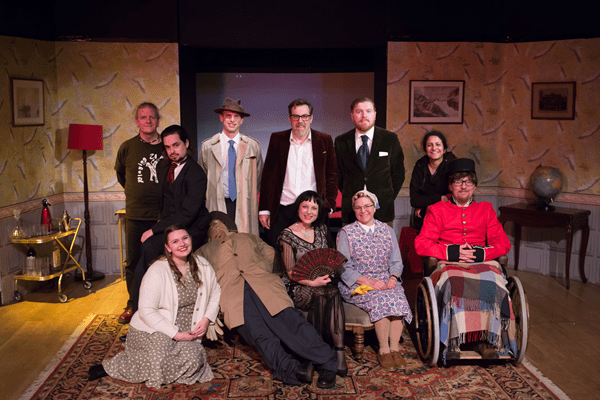
“The Real Inspector Hound”, at the Rondo Theatre, Larkhall, Bath, November 8th 2024.


by Ian Diddams
images by Playing Up Theatre Company

When is a mousetrap not a mousetrap? When it’s written by Tom Stoppard…
If you have seen “The Mousetrap” you may find elements of “The Real Inspector Hound” quite familiar. Or alternatively, if once having seen “The Real inspector Hound” you then progress to seeing “The Mousetrap” you may find elements of that show quite familiar…

“The Mousetrap” of course being a play by Agatha Christie that is the London West End’s longest running play, performed ever since 1952 with only a lockdown enforced break in all that time. Famously, audiences are asked not to reveal the solution.  Tom Stoppard, allegedly, found this requirement somewhat tedious and so set out to write his own, similar, play.  You would ideally want to see both however to fully understand what he created.

“The Real Inspector Hound” is also famously known for being a play-within-a-play; that is, a play in a theatre where the story is about a play. Stoppard though arguably takes this one step further especially as the surreal activities of the second half of the play unfold, as it becomes a play within a play within a play…  the complexities of what that entails are best learned by seeing Stoppard’s excellently bizarre play!

The Playing Up Theatre Company present this show this week at the Rondo, Theatre, Larkhall, on the eastern extremities of Bath. In it they take Stoppard’s already surreal comedy and add even more layers to it…  not only is their performance of Stoppard’s urine extraction of Agatha Christie, but they have added hilarious homages to “The Play That Goes Wrong,” “Acorn Antiques” and even “Monty Python,” especially in the first half – the second half is bonkers enough to not need any additional layers, but the surrealism is excellently portrayed with good pace and no blinking of an eyebrow – audiences need to stay awake and in tune and to have listened attentively to the opening fifteen minutes to get all the nuances going on!

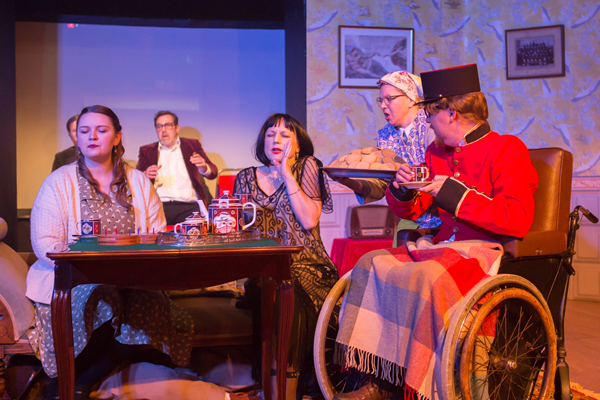
Stoppard used to be a theatre critic himself, and uses this knowledge as a vehicle to extract the urine to that demographic. The two critics, Moon and Birdboot, played by Andrew Chapman and Simon Shorrock respectively, certainly portray two characters full of self-importance and one upmanship, though from opposite ends of the ethical spectrum and the two actors capture this interaction excellently. James Coy adeptly and gruffly spins his way around the stage in a wheelchair as the physically challenged brother-in-law Major Magnus Muldoon, overly protective of his sister-in-law and threatening dark retribution to any man displaying intentions towards her. But is he what he seems to be ?

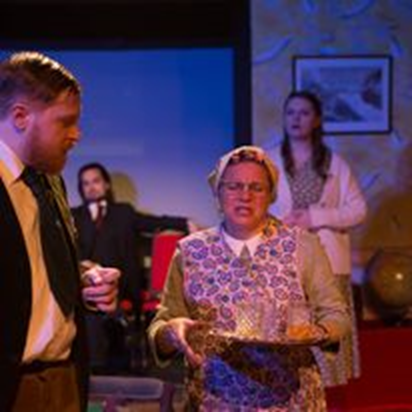
The star of the show – if one may be permitted to pick any one actor out of a superb line out anyway – for me though was Anne Hipperson as Mrs. Drudge the housekeeper. Her self-confessed homage to Mrs Overall from “Acorn Antiques” is perfect – some exquisite comedic timing. The only thing missing from the portrayal was Stoppard failing, sadly, to provide her with a line of “Two sugars” during the painfully brilliant coffee scene.

Simon Gascoyne, smooth, suave, and sophisticated wooer of women was played by Jordan Phillpots, oozing self-confidence and smarm from every pore, while Felicity Cunningham, played by Leah Brine, the breathless, suspicious, doubly wooed young lady was suitably, deliciously aghast at the abhorrent menfolk in her life.

Then there was the almost obligatory femme fatale for such country house whodunnits – Sophie Brooks as Lady Cynthia Muldoon. Outwardly a devoted wife to her missing husband, but privately a hot bed of passion for passing fancies, Sophie mixed M’Lady’s brooding, sultry character in the farcical first act, and surreal second half to perfection, another actor with perfect comedic timing.


Which leaves just Inspector Hound himself – as ever perfectly played by the ever talented Richard Chivers. Or then again – is he the “Real Inspector Hound”?


That leaves just one more character on stage … mentioned several times, but hidden, then revealed – twice. No names, no pack drill, but the character never puts a foot out of place, and remains faultlessly in character and on stage for the entire show.

The set, by cast and crew, is a simple one as befits a typical country house murder mystery, with the use of the Rondo’s rear “cubby hole” option as the theatre seats used by Moon and Birdboot. Costumes fitted the period setting of 1930s upper class types, and technical design, operation and support was handled with aplomb by Darian Nelson and Emily Smith. This just leaves kudos for wonderful direction by Darian Nelson, abetted by superb stage management – also stepping into the fold of tech team for technical reasons – by Diluki O’Beirne.

I can’t praise this performance enough. From the pure delivery of Stoppard’s farcical surrealism, to the directorial tweaks and homages so well delivered by the cast, to use of Bluetooth technology to really sell on stage audio, everything gelled so well.

So all that remains now is to advise you all – go and see this play wherever you can and see if you can spot who is…  “The Real Inspector Hound.”