
If Dunbar’s number is a thing, then isn’t it a human instinct, be it more than a wish but perhaps a need, to group people outside of your given sphere? Does this constitute prejudges, and are they therefore ingrained in society through nurture and history? I’m continuing to bash on about Black History month before it’s over; remember, no one is forcing you to read this!
An evening in the mid-nineties and the Dreadzone gig at the Shepard’s Bush Empire ended. Me, a tad intoxicated, has drawn the short straw, gathered friend’s cloakroom tickets and patiently wobbled in the crammed queue to retrieve our jackets. A couple in front had found love, or lust at least, and I mean directly in front, like, so close if I wanted, I could have joined in. Pecking very nearly turned to copulating, as the couple furiously exchanged salvia. I confess, I was nauseous and uncompromising, the queue packed so tight it was difficult to concentrate my path of vision elsewhere, and even if I did, I could not disguise the sound of their slurping.
Now, I fully accept my mouth can override my sensitivity in times of intoxication, yet to me I enquired of the couple politely. I’m pleased for them, that they found mutual attraction and desired to explore it, but I wished they could wait until somewhere a tad more private. My subtle approach, if memory serves me right, was to say, “oi, do you have to do that here?” They retorted and accused me of homophobia, as they were a same sex couple. I affirmed I was no such thing, and annoyed by the accusation I replied it was nothing to do with gender, if they were a heterosexual couple I’d have been equally as irritated. Yet, till this day, I worry myself, were they right? Does this mean I’m homophobic?
Personally, the idea of myself engaging sexually with a guy is defo off the cards, but I like to think I’ve a liberal opinion and I accept others feel different. I know homosexuality happens in nature, I’m aware homosexuals were persecuted in the past, and I support the ethos of live and let live. But I’m nerved by the incident, and wonder if I might have reacted differently if they were heterosexual. I even contemplate if my attitude would be different if they were both female; might have perversely enjoyed the show; there, I said it, I’m only human! Is this an ingrained prejudice I’m unaware of, or mechanically unprepared to accept? I’m not ruling it out.
If you figure I tend to write these opinion pieces with a theme of personal perfection, that I do not stand accused myself, I give you this. Yet, I’d still be angered by a reaction of someone who falls into this grouping who states, yep, I’m afraid you are a hypocritical homophobic denier, defo, because I am adamant, I am not. I see the same reaction by a few in my recent articles about racism. They are unyieldingly positive they are not racist, to the point I believe they genuinely consider they are not. But, are they? “Repeat a lie often enough and it becomes the truth,” is a law of propaganda often attributed to the Nazi Joseph Goebbels.
Yet, as evident in the parish council’s refusal to display an exhibit in their phonebox on the theme from their village youth, they criticise recent motives and analyse with a natural bias, it seems to me. Yet the council in Urchfont are volunteer residents and is, obviously, not systematically racist. But I have to wonder if our history has ingrained prejudges into us, be it via the slave trade, The Buggery Act of 1533, passed by Parliament during the reign of Henry VIII, punishable by death, or every attitude pre-The Chartist Movement of 1838, and, of course, the Women’s Social and Political Union formed in 1903.
Though, despite the umpteen explanations the slogan, for it is such, black lives matter doesn’t mean that all lives do not, it’s still paraded around as rejoinder. Yes, small groups may’ve used the slogan in their name, and some may be activistic, the motto is simply decentralised social movements advocating for non-violent civil disobedience, and in any protest, some will disobey the objective and cause trouble.
A campaign only becomes political if a dogmatic rule opposes it. Negative reactions of the president, our own drive here in Britain to disengage immigration policy, remarks from our own royal family and jokes made by our prime minister, and, obviously, the murder of George Floyd, suggests it is. Unfortunate as it may be, often such a violent reaction is what it takes to raise awareness and change. On 19th February 1913 a bomb brought down ceilings and cracked walls in the home of the Chancellor of the Exchequer, Lloyd George; Emmeline Pankhurst claimed responsibility. Suffragettes smashed windows, cut telephone lines, spat at police and politicians, cut or burned slogans into turf, sent letter bombs, destroyed greenhouses at Kew gardens, attacked a doctor was with a rhino whip, chained themselves to railings and blew up houses. 1912, Mary Leigh threw a hatchet at Prime Minister H. H. Asquith, for change we now consider ludicrous not to uphold.
In this I see agism too, the campaign is worse than anything you recall with rose-tinted specs. “Times are bad. Children no longer obey their parents, and everyone is writing a book.” Who said this, was it recent? Answer; Marcus Tullius Cicero, 43 BC, Rome.
I’m permitted to quote Keith Rowe of the classic reggae duo, Keith & Tex, when back in June he posted these thoughts; “As I digest this moment in time and observe what’s been going on in this country [USA], I am disappointed, yet hopeful, that maybe this time there will be changes in policing.
Disappointed that it would take an uprising to get people’s attention to what African Americans have been experiencing for generations. It took this latest despicable video of George Floyd to realize that this has been our reality. I’m hopeful because it’s the young people that are leading this protest. Let’s not forget that back in the 60s, protests were being led by young people. Martin Luther King was only 26 when he started leading the nonviolent protests.
We need an end to systemic racism and it’s good to see multigenerational, multicultural protests going on in many cities. You’re either a racist or an anti-racist, there is no in between. Having served the military for 20 years, I am amazed at how militarized the police have become. I’ve never heard before civilian protests referred to as a “Battlespace” It’s as if they are facing an enemy force and are going to battle them in the streets. We need to relook at how policing is done in this country and make drastic changes. It just can’t go on like this. Black Lives really do Matter!”
I left this quote unedited, as I thought it inspiring, heartfelt and an honest reflection, but, the subject of this series or articles was principally intended to focus on a local issue. Racism is wrought, everywhere. How do we compare? To put it mildly, we’re in the thick of affluence, much of which is unescapably the profits of the slave trade. Consider Simon Watson Taylor, to name but one, the MP for Devizes from 1857 to 1859. His family derived its wealth from sugar and slavery in the Colony of Jamaica. In 1852, Simon Watson Taylor inherited his Jamaican estates from his mother Anna, he lived…guess…at Urchfont Manor.
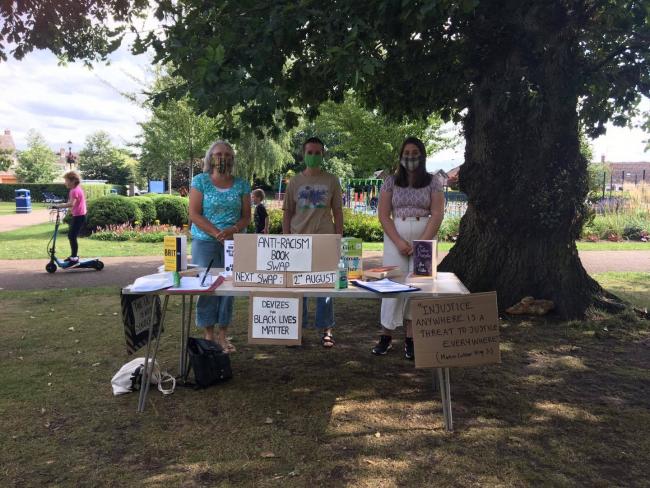
Taking the advice given at my online meeting with Gurpreet Kaur of BLMintheStix, an organisation addressing racism in rural areas, to be open and unafraid to discuss the subject with those affected, I did chat with a Jamaican-born friend living here. He messaged me, to say he found my article interesting. I suggested the Urchfont phone box issue is bizarre, stating I didn’t believe those parish councillors are deliberately being prejudiced, but they’ve believed the media propaganda against BLM and constitute any reference to racism as being arranged by some political activist organisation, enough to stop children of their own village displaying an art exhibit. As an artist himself, he replied, “that is sad,” and was keen to point out, “how it was, how it is and how it will always be.” Though he expressed content living here and said he had no issues in his village, “all very friendly. Happy at my yard.” Here is an important point I tend so see here, the negativity is rarely cast upon an individual locally, and for this much alone, we should be grateful.
I therefore stand by my original observation, no particular place could be viewed as more or less racist than any other, our own stands well and we should be proud of this. But we do need to consider this current movement is no more violent or dogmatically driven than any other previous campaign on any particular issue, it’s only a media interpretation of, their reasoning for is a drop in the ocean for debate I’m not willing to speculate without another two-thousand words. Which, we don’t need me harking on even more!
So, to conclude, before my fingers fall off, I feel our prejudges are indeed inherited and ingrained upon us unwillingly, and this is no one’s fault. But we should want to address them, and strive to change, so there will be a possibility that they will be eradicated in the future. As is the section of Haile Selassie’s 1963 address to the United Nations, recited by Bob Marley in his song War; “that until the philosophy which holds one race superior and another inferior is finally and permanently discredited and abandoned; that until there are no longer first class and second class citizens of any nation; that until the colour of a man’s skin is of no more significance than the colour of his eyes; that until the basic human rights are equally guaranteed to all without regard to race; that until that day, the dream of lasting peace and world citizenship and the rule of international morality will remain but a fleeting illusion, to be pursued but never attained.”
If I thought for a second it is but a fleeting illusion, to be pursued but never attained, then there is no hope. I know it’s doubtful I’ll ever see that kissing couple in the Shepard’s Bush Empire again, wouldn’t recognise them if I did, but if I did I’d like to say, “I sincerely hope you are wrong when you surmise I’m homophobic, but if not, and I am, I intend to change my view.” For a generation whose grandparents stared in shock at Boy George on Top of the Pops in 1983, we have come so far. And to watch same-sex couples unquestioned on game shows and reality TV, and accredited children’s cartoons such as the ground-breaking “The Loud House,” which openly has the protagonist’s best friend parented by a gay couple, I have to be proud as a generation we have nearly attained equality. Yet I quiver and anger at the notion this is slowly being torn down around us.
Return this back to our original article, our interview with Gurpreet, when I asked “are racist attitudes increasing?”
“Only if we let it,” Gurpreet replied.







 devizine.com