
Words by Ollie MacKenzie.
Featured Image by Barbora Mrazkova.
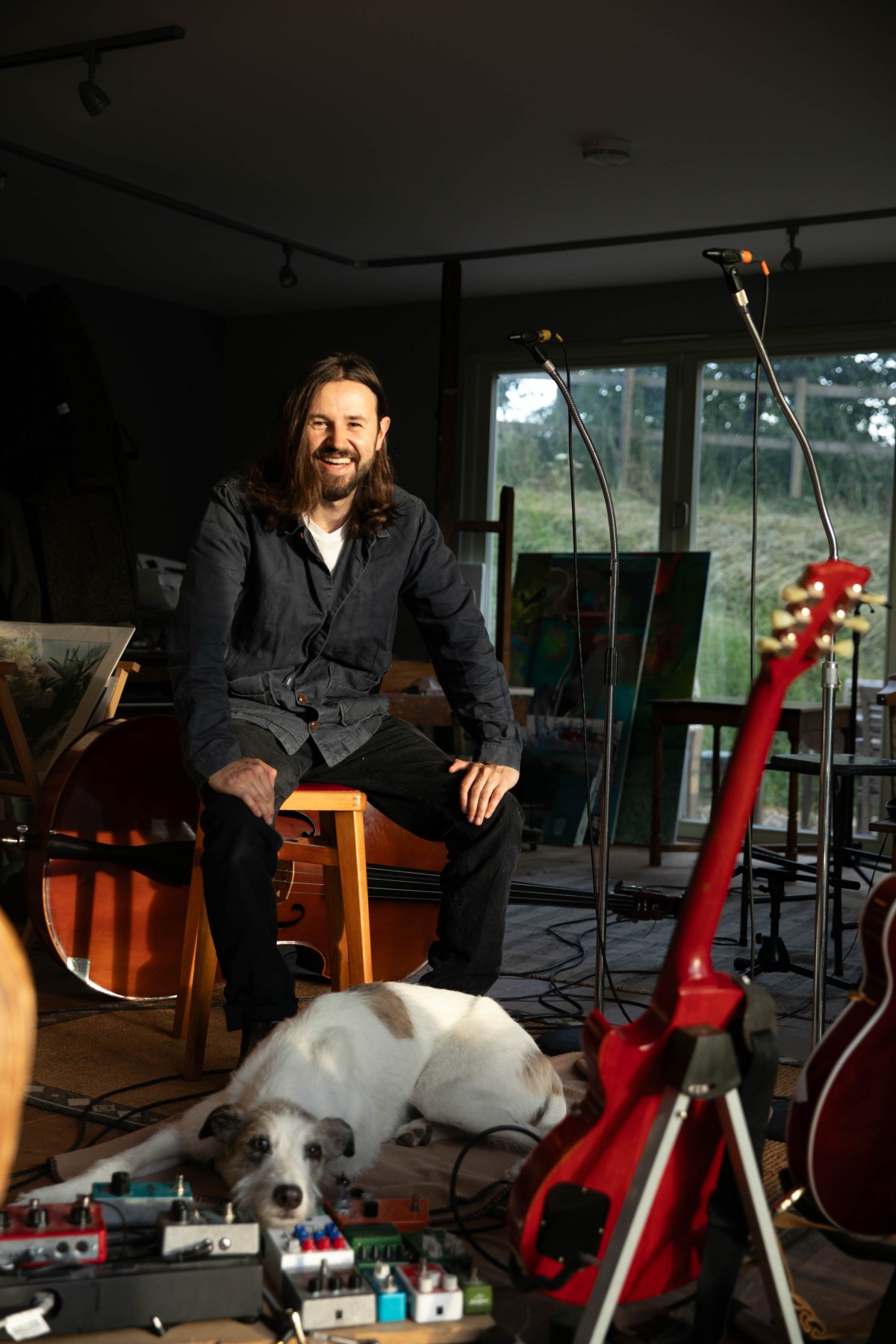
The creative process can be a winding, long, and often confusing journey. Seeing a project come to fruition from scrappy origin to a packaged, marketable, and well-rounded piece of work can feel daunting – or even impossible. It took Gus White six years of honing his production skills, amassing an arsenal of musical machinery, and developing a community of talented musicians to bring his album ‘For Now, Anyway’ into existence….
At its core, it’s a breakup album, which could feel strange to complete and release so far after the original ‘break’, but speaking to Gus it appears the space has allowed him to finish the album at a much more present and content time in his life. He’s settled into a different existence – he’s in a new relationship, he’s a dog owner, and has played a large role in building a thriving music scene across the venues, pubs, and houses of Wiltshire.
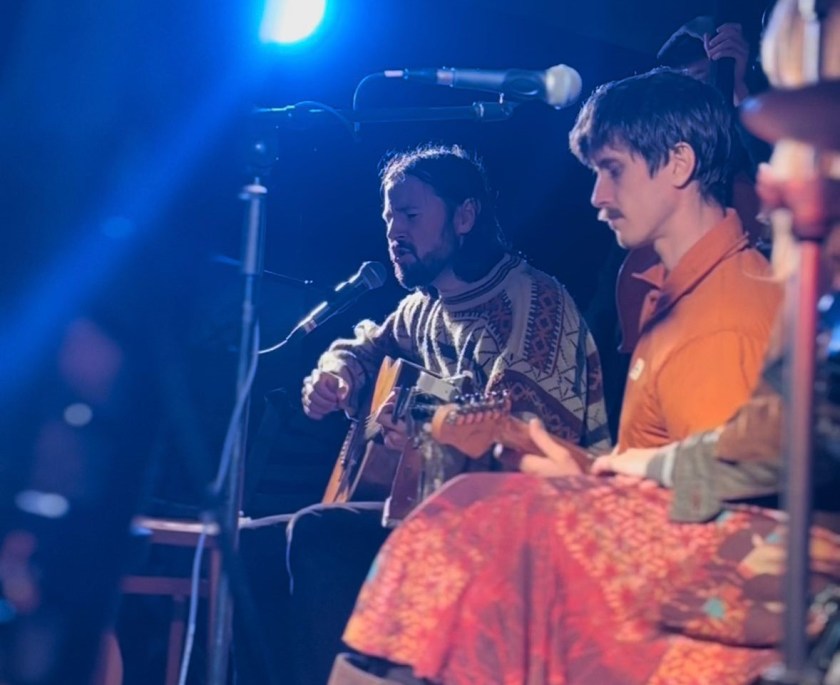
This brings us to the Smithy Art Forgery in Burbage, a kooky yet loveable cultural venue operating out of a 375-year-old house that currently operates as a jeweller. Located on the side of a quiet village road, it’s adorned with nondescript street parking, burgers served off a BBQ, and vegetable curry to order made in the owner’s kitchen.
It’s these types of places that are few and far between according to Gus – a true grassroots venue for musicians, a haven from playing dusty forgotten corners of pubs where the landlord and patrons don’t even really want you there anyway. It was why it was there on the 14th of September that Gus hosted his album release party.

Taking place in the back garden of the venue, attendees were seated under a marquee packed with various sofas, stools, and garden furniture that faced onto an embankment where the stage was set. Copious instruments lay there waiting, tucked underneath an array of tarpaulin and teepees to shield them and the musicians from the bipolar weather conditions of the changing season.
The atmosphere was intimate – maybe fewer than 100 in attendance – but one that felt lively and far from empty. Friends of friends of friends made happy introductions and chats to one another, waiting for the music to start. Two support acts opened the day. First, a solo and entrancing guitar performance from Grace Elizabeth Harvey, followed by a sort of double act from Ann Liu Cannon and Esmé White, the two swapping between lead vocal spots all the while backed by a mandolin player – the first of many off-kilter instruments to litter the performances.
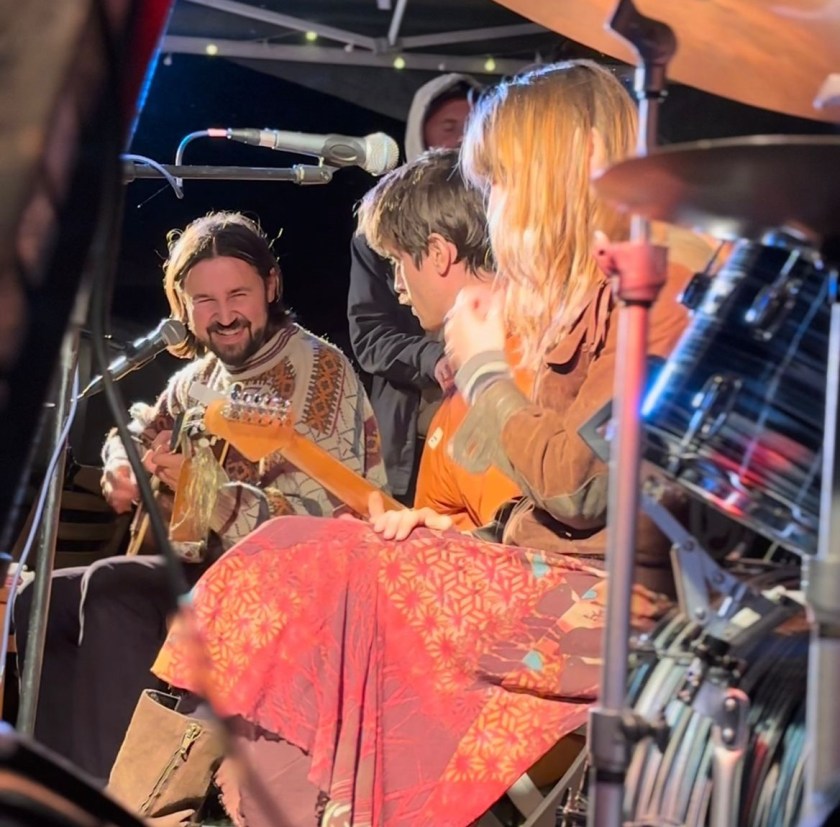
Then it was Gus’s turn to play. The performance brought about the live, interactive feel of the album, with a high range of instruments on display — trombones, sublime guitar passages, the double bass, a kazoo solo, and even a set of pots and pans, just to name a few. The music felt sonically based in the past, a careful homage to folk and rock formats from americana, country and indie, exhibiting a range of influence from the 50s all the way to the 70s. Despite its seemingly traditional backdrop, the performance was unmistakably modern, with the lyrics carrying the music firmly into the present. Packed with new-age irony and technological references, Gus’s dry, irreverent humour was centre stage throughout the performance, both in the songs and in his preambles — though this didn’t disguise the sincerity of the music or the performer. Balanced amongst the tongue-in-cheek lyrics were very straight to the point personal accounts of his former relationship, that through their intense and biographical nature revealed a relatability that would be shrouded behind overt poeticism. Though typically robust and amusing, Gus’s songwriting shows a capability of reaching into the elegiac also. The solo encore of ‘Josephine’ makes the case for Gus’s well-roundedness as a song smith; a poetry laden tribute to his partner that drew much of its effect from its earnestness and folk-style imagery.
Gus closed the concert with a rendition of ‘Please Forgive Me’, a rousing finish that allowed each band member their moment to show off, before the crowd sung the concert to a finish. It felt an appropriate end, where Gus, the producer, allowed others to have their moment through his handiwork, sitting back and revelling in the fun of it all. For a set of songs about breaking up, Gus seemed married to the moment, an artist revealing himself at a perfect time to a welcoming group of friends and strangers alike.


Trending…..
An Endless Summer with Braydon-Lee’s New Single
If, inspired by the likes of Ed Sheeran and James Arthur, the majority of Gen Z loves a good power ballad, the beginnings of the…
Keep reading
Tour Des Frites: Four Dauntseys’ Sixth-Formers Awarded Travel Scholarship Cycle from School to Bonn, Germany
Four Dauntsey’s Sixth-Formers have been awarded travel scholarships, and plan to cycle all the way from their school to Bonn in Germany, shortly after completing…
Keep reading
Wiltshire Business Leader to Host Free International Women’s Day AI Webinar to Prevent Women Being “Left Behind” in Tech Shift
Leading Wiltshire digital entrepreneur Natalie Luckham, AI Educator and founder of award-winning Wiltshire social media consultancy Naturally Social is hosting a free “Introduction to AI”…
Keep reading
The Return of The Fold Music Venue in Devizes
If your average Tuesday night in Devizes might feel like The Day The Earth Stood Still, it certainly felt this way for me yesterday; I…
Keep reading
Dulcet Tones Rock Back to Bassett!
You’re a teenage Tom Cruise, at least you wish you were, but stay with me on this! Your parents are away, you’re home alone with…
Keep reading
Talk in Code Headlined Devizes Winter of Festive Ales
Devizes Outdoor Celebratory Arts key into the town’s majority demographic for its first annual event of the year, mature couples, with an affection for sampling…
Keep reading
The Munster Returns to Slam-Dunk Wiltshire Council Budget!
Well, I admit, the Black Dog Crossroads has reopened with shiny new traffic lights and looks pretty groovy, as far as road junctions look groovy.…
Keep reading
Wiltshire Music Awards 2026 Announces New Organisers and Major Event Upgrade
The Wiltshire Music Awards 2026 entered an exciting new era when Stone Circle Music Events announced was as official sponsor and organiser. Backed by their…
Keep readingSomething went wrong. Please refresh the page and/or try again.
 devizine.com