UrchFunk; The Forgotten Tale of How George Clinton Created Funk Music in the Wiltshire Village of Urchfont

You’d be forgiven for believing funk music came out of Detroit in the early seventies, when it is a little known fact, obscured and deliberately hidden, likely for the prestige of the American city and the ignominy of the village, that funk music was actually created in the Wiltshire village of Urchfont….

Funk pioneer George Clinton and bandleader of the collective Parliament-Funkadelic was born in North Carolina and grew up in New Jersey, moving to Detroit in the mid-sixties to work as a songwriter for Motown. By the early seventies Clinton and several members of the band settled in Toronto, but during this time he encountered legal difficulties arising from acquisitions of his record label, resulting in dangerous circumstances and was secretly exiled to England, settling in Urchfont for a few short months.

It was in solitude at the sleepy Wiltshire village where Clinton honed the funk style based on the recordings of James Brown. Developing an association with a few village musicians who had formed a skiffle group on his lonely walks to the village pond from his home in Cuckoo Corner, Clinton convinced them to create a new band. Clinton called them Urch-Funk. The band would play to a small crowd in the village hall, and even daringly attempted an ambitious outside gig around the pond.

After a short while, Clinton got the all clear from his record label, and made his way back to Toronto, taking the idea of funk music back with him, but not without leaving a significant influence in the village. What happened next was a secret funk phenomenon in the village, now sadly hidden; I wanted to know why.

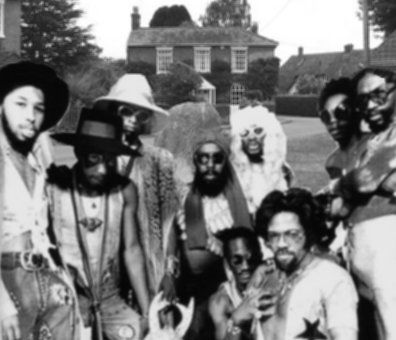
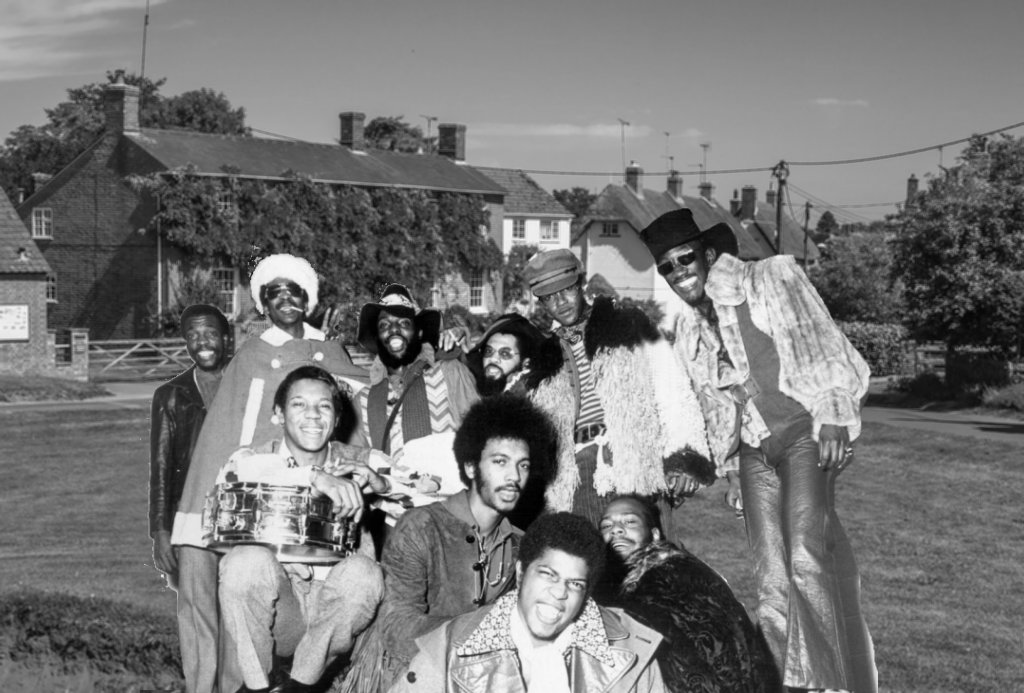
1973: Parliament-Funkadelic visits Clinton in Urchfont

A villager, who prefers to remain anonymous, revealed, “yarp, they bee dancin’ ‘n’ singin’, arn movin’ ter thar groovin’, arn joist wen wun hit me, with argh bloody shovel I mioght add, I turned arand I dids, n shouted play art funky music Urchfunk boi!”

But, it was not a case of one village under a groove. Some villagers and the parish council have deliberately made my research as difficult as possible. My initial discovery of a disco ball buried in mud for decades and only unearthed when the new houses at Peppercombe were built, led me to wonder how it came to be there. I returned to the site to discover disregarded afro wigs and flyers for soul all-nighters at the village hall. But everyone who I approached refused to talk, accusing me of creating a hoax.

Some even chased me out the village with pitchforks and torches, calling me to not unearth Urchfont’s secret funkadelia past, if I knew what was “gard fur me!” This naturally roused my suspicions that Urchfont held a direct secret link to funk music, a majority were embarrassed by it and, it seemed, were willing to kill to protect the secret. I had to know more.

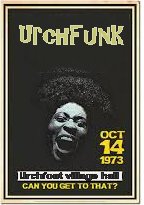
A rare flyer for an UrchFunk gig at the Village Hall

I took to returning to the village to hunt for more clues by the cover of night, but I found nothing. Until one evening, so frustrated my searching was unfruitful, I stayed all night looking, and early morning joggers and dog walkers were emerging from their homes. Ducking stealthily into Stone Pit Lane, a strange looking old man appeared from out of the bushes and clasped his hand over my mouth, stating, “cum wiff me if yer wanna live… groovy!”

He took me to a secret lair in the undergrowth which appeared to be a shrine to Urchfont’s forgotten past. Within this hobbit hole of treasures he allowed me to browse, and as I did he told me his story. He was one of musicians who met Clinton, and who had created the definitive sound of funk which would soon take America by storm. But he told me how the local folk club banished them, believing funk was the work of the devil, but really, he suspected it was more likely because they upstaged them, with glitter, and platform shoes with goldfish in them, which later they declared was animal cruelty. The fish were released into the village pond.

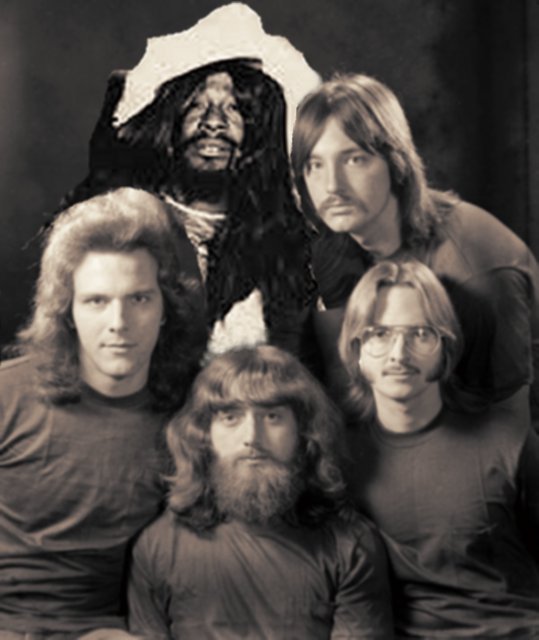
Likely the only existing photograph of UrchFunk. Believed to have been taken at the Urchfont Village Hall in 1973.

They were simply excuses, the man dressed in worn purple corduroys and flowery dagger collar shirt, informed me. He explained how the folk club encouraged the entire village and council to hide Urchfont’s funky disco days, as it was considered untraditional and could radicalise the young people of the village into wearing sequined jumpsuits.

“Hoy,” he said, “once eye bee argh boogie singer, playin’ in argh rock-and-roll band, see? Never ‘ard no prublems, me, yer nose, ganderflankin’ down thar one-night stands, like. N everything arand me gart ter start ter feelin’ so low, so eye decided quickly, yarp, eye dids, ter disco down an’ check art thar show, praper jarb!”

1973: Parliament-Funkadelic visits Clinton in Urchfont

Once settled down from his excitement of my arrival, the old man continued with his amazing story. Clinton tried to organise a funk festival in the village which he called the Afro-Festival, which the old man claimed once Clinton left for America the parish council changed the name of it to the Scarecrow Festival. The outside gig around the pond, Disco Balls Around the Pond was swiftly changed to Candles Around the Pond, and the village’s connection to funk was forever swept under the carpet, save for when the wind blows south east across Sleight.

I remain steadfast that this forgotten past of Urchfont should be exposed, and celebrated; the village should be proud of it’s funky past. Therefore, I’m glad to be able to finally publish this information after many years of research, today, the 1st April 2025.  


The Conclusion to my Black History Month Articles….

If Dunbar’s number is a thing, then isn’t it a human instinct, be it more than a wish but perhaps a need, to group people outside of your given sphere? Does this constitute prejudges, and are they therefore ingrained in society through nurture and history? I’m continuing to bash on about Black History month before it’s over; remember, no one is forcing you to read this!

An evening in the mid-nineties and the Dreadzone gig at the Shepard’s Bush Empire ended. Me, a tad intoxicated, has drawn the short straw, gathered friend’s cloakroom tickets and patiently wobbled in the crammed queue to retrieve our jackets. A couple in front had found love, or lust at least, and I mean directly in front, like, so close if I wanted, I could have joined in. Pecking very nearly turned to copulating, as the couple furiously exchanged salvia. I confess, I was nauseous and uncompromising, the queue packed so tight it was difficult to concentrate my path of vision elsewhere, and even if I did, I could not disguise the sound of their slurping.

Now, I fully accept my mouth can override my sensitivity in times of intoxication, yet to me I enquired of the couple politely. I’m pleased for them, that they found mutual attraction and desired to explore it, but I wished they could wait until somewhere a tad more private. My subtle approach, if memory serves me right, was to say, “oi, do you have to do that here?” They retorted and accused me of homophobia, as they were a same sex couple. I affirmed I was no such thing, and annoyed by the accusation I replied it was nothing to do with gender, if they were a heterosexual couple I’d have been equally as irritated. Yet, till this day, I worry myself, were they right? Does this mean I’m homophobic?

Personally, the idea of myself engaging sexually with a guy is defo off the cards, but I like to think I’ve a liberal opinion and I accept others feel different. I know homosexuality happens in nature, I’m aware homosexuals were persecuted in the past, and I support the ethos of live and let live. But I’m nerved by the incident, and wonder if I might have reacted differently if they were heterosexual. I even contemplate if my attitude would be different if they were both female; might have perversely enjoyed the show; there, I said it, I’m only human! Is this an ingrained prejudice I’m unaware of, or mechanically unprepared to accept? I’m not ruling it out.

If you figure I tend to write these opinion pieces with a theme of personal perfection, that I do not stand accused myself, I give you this. Yet, I’d still be angered by a reaction of someone who falls into this grouping who states, yep, I’m afraid you are a hypocritical homophobic denier, defo, because I am adamant, I am not. I see the same reaction by a few in my recent articles about racism. They are unyieldingly positive they are not racist, to the point I believe they genuinely consider they are not. But, are they? “Repeat a lie often enough and it becomes the truth,” is a law of propaganda often attributed to the Nazi Joseph Goebbels.

Yet, as evident in the parish council’s refusal to display an exhibit in their phonebox on the theme from their village youth, they criticise recent motives and analyse with a natural bias, it seems to me. Yet the council in Urchfont are volunteer residents and is, obviously, not systematically racist. But I have to wonder if our history has ingrained prejudges into us, be it via the slave trade, The Buggery Act of 1533, passed by Parliament during the reign of Henry VIII, punishable by death, or every attitude pre-The Chartist Movement of 1838, and, of course, the Women’s Social and Political Union formed in 1903.

Though, despite the umpteen explanations the slogan, for it is such, black lives matter doesn’t mean that all lives do not, it’s still paraded around as rejoinder. Yes, small groups may’ve used the slogan in their name, and some may be activistic, the motto is simply decentralised social movements advocating for non-violent civil disobedience, and in any protest, some will disobey the objective and cause trouble.

A campaign only becomes political if a dogmatic rule opposes it. Negative reactions of the president, our own drive here in Britain to disengage immigration policy, remarks from our own royal family and jokes made by our prime minister, and, obviously, the murder of George Floyd, suggests it is. Unfortunate as it may be, often such a violent reaction is what it takes to raise awareness and change. On 19th February 1913 a bomb brought down ceilings and cracked walls in the home of the Chancellor of the Exchequer, Lloyd George; Emmeline Pankhurst claimed responsibility. Suffragettes smashed windows, cut telephone lines, spat at police and politicians, cut or burned slogans into turf, sent letter bombs, destroyed greenhouses at Kew gardens, attacked a doctor was with a rhino whip, chained themselves to railings and blew up houses. 1912, Mary Leigh threw a hatchet at Prime Minister H. H. Asquith, for change we now consider ludicrous not to uphold.

In this I see agism too, the campaign is worse than anything you recall with rose-tinted specs.  “Times are bad. Children no longer obey their parents, and everyone is writing a book.” Who said this, was it recent? Answer; Marcus Tullius Cicero, 43 BC, Rome.

I’m permitted to quote Keith Rowe of the classic reggae duo, Keith & Tex, when back in June he posted these thoughts; “As I digest this moment in time and observe what’s been going on in this country [USA], I am disappointed, yet hopeful, that maybe this time there will be changes in policing.

Disappointed that it would take an uprising to get people’s attention to what African Americans have been experiencing for generations. It took this latest despicable video of George Floyd to realize that this has been our reality. I’m hopeful because it’s the young people that are leading this protest.  Let’s not forget that back in the 60s, protests were being led by young people. Martin Luther King was only 26 when he started leading the nonviolent protests. 

We need an end to systemic racism and it’s good to see multigenerational, multicultural protests going on in many cities. You’re either a racist or an anti-racist, there is no in between. Having served the military for 20 years, I am amazed at how militarized the police have become. I’ve never heard before civilian protests referred to as a “Battlespace” It’s as if they are facing an enemy force and are going to battle them in the streets.  We need to relook at how policing is done in this country and make drastic changes. It just can’t go on like this. Black Lives really do Matter!”

I left this quote unedited, as I thought it inspiring, heartfelt and an honest reflection, but, the subject of this series or articles was principally intended to focus on a local issue. Racism is wrought, everywhere. How do we compare? To put it mildly, we’re in the thick of affluence, much of which is unescapably the profits of the slave trade. Consider Simon Watson Taylor, to name but one, the MP for Devizes from 1857 to 1859. His family derived its wealth from sugar and slavery in the Colony of Jamaica. In 1852, Simon Watson Taylor inherited his Jamaican estates from his mother Anna, he lived…guess…at Urchfont Manor.

Taking the advice given at my online meeting with Gurpreet Kaur of BLMintheStix, an organisation addressing racism in rural areas, to be open and unafraid to discuss the subject with those affected, I did chat with a Jamaican-born friend living here. He messaged me, to say he found my article interesting. I suggested the Urchfont phone box issue is bizarre, stating I didn’t believe those parish councillors are deliberately being prejudiced, but they’ve believed the media propaganda against BLM and constitute any reference to racism as being arranged by some political activist organisation, enough to stop children of their own village displaying an art exhibit. As an artist himself, he replied, “that is sad,” and was keen to point out, “how it was, how it is and how it will always be.” Though he expressed content living here and said he had no issues in his village, “all very friendly. Happy at my yard.”  Here is an important point I tend so see here, the negativity is rarely cast upon an individual locally, and for this much alone, we should be grateful.

I therefore stand by my original observation, no particular place could be viewed as more or less racist than any other, our own stands well and we should be proud of this. But we do need to consider this current movement is no more violent or dogmatically driven than any other previous campaign on any particular issue, it’s only a media interpretation of, their reasoning for is a drop in the ocean for debate I’m not willing to speculate without another two-thousand words. Which, we don’t need me harking on even more!

So, to conclude, before my fingers fall off, I feel our prejudges are indeed inherited and ingrained upon us unwillingly, and this is no one’s fault. But we should want to address them, and strive to change, so there will be a possibility that they will be eradicated in the future. As is the section of Haile Selassie’s 1963 address to the United Nations, recited by Bob Marley in his song War; “that until the philosophy which holds one race superior and another inferior is finally and permanently discredited and abandoned; that until there are no longer first class and second class citizens of any nation; that until the colour of a man’s skin is of no more significance than the colour of his eyes; that until the basic human rights are equally guaranteed to all without regard to race; that until that day, the dream of lasting peace and world citizenship and the rule of international morality will remain but a fleeting illusion, to be pursued but never attained.”

If I thought for a second it is but a fleeting illusion, to be pursued but never attained, then there is no hope. I know it’s doubtful I’ll ever see that kissing couple in the Shepard’s Bush Empire again, wouldn’t recognise them if I did, but if I did I’d like to say, “I sincerely hope you are wrong when you surmise I’m homophobic, but if not, and I am, I intend to change my view.” For a generation whose grandparents stared in shock at Boy George on Top of the Pops in 1983, we have come so far. And to watch same-sex couples unquestioned on game shows and reality TV, and accredited children’s cartoons such as the ground-breaking “The Loud House,” which openly has the protagonist’s best friend parented by a gay couple, I have to be proud as a generation we have nearly attained equality. Yet I quiver and anger at the notion this is slowly being torn down around us.

Return this back to our original article, our interview with Gurpreet, when I asked “are racist attitudes increasing?”

“Only if we let it,” Gurpreet replied.

Urchfont Parish Council Turn Down Youth Art Display

Further to my article reflecting on black history month, and our chat with BLM in the Stix organiser Gurpreet Kaur, I said I had a local issue to raise which could be conceived as the perfect example of the message I’m trying to get across regarding rural racism so ingrained we fail to recognise it, or simply don’t care to consider it as such. I was waiting for a response from relevant sources in order to give an impartial valuation. In the meantime, the good ol’ Gazette & Herald beat me to it!

In all fairness they didn’t make a bad job, but it’s the reactionary and presumptuous comments flowing on social media where the story warps out of all proportion and skewers the facts; keyboard warriors tend to do that.

Urchfont Parish Council’s Chairman, Graham Day explains, “at its meeting on 8th July, Urchfont Parish Council discussed a proposal for a possible use of the High Street telephone box which is owned by the Council. A lengthy debate on this matter took place, with substantial public input both from those present at the meeting and others who had submitted comments to our Clerk.”

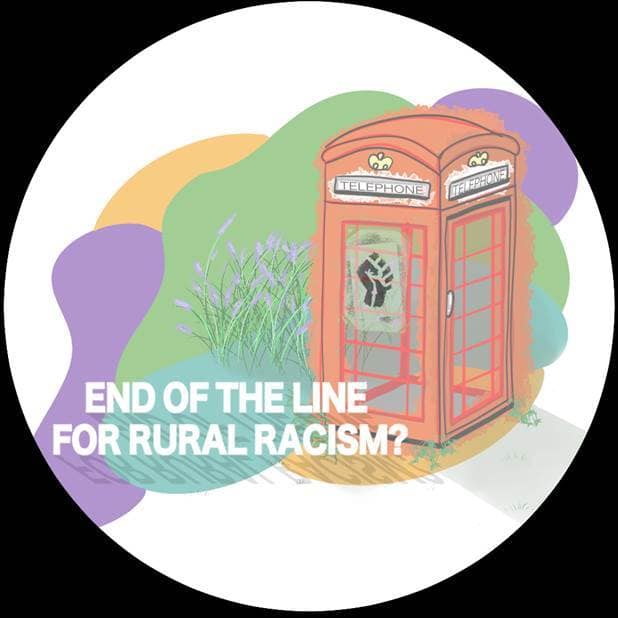
As with many rural out of service phone boxes, the community has gathered to find alternative usage for it. Many have become community hubs, noticeboards and others rural self-governed lending libraries. Urchfont’s phone-box was adopted by the Parish Council in 2018, “to protect it and to provide an unusual venue to promote village events and,” here’s the biting point taken from the phone box’s own Facebook page, “showcase work by local groups.”

So, members of such a group, Youth Of Urchfont, moved by recent racial injustices, proposed a display presenting art and literature on the theme of racism. Immediately the goalposts are moved, and the ethos of the phone box altered by councillors, stating, “the telephone box should be used only for local community purposes, as such this proposal covering the wider issue of racism should be rejected.”

For the first few minutes of the agenda’s proposal by the teenagers everything seems to be going well. But as the discussion flowed, it appeared an assumption the idea was linked to black lives matter, which rather than a slogan, is perceived by villagers to be an organised political movement.  Intent to maintain the Parish Council is a non-political body, it rejected the proposal five votes against three.

Spirally out of control, social media comments claimed all manner of fabrications, such as the youth wished to paint the phonebox. It hardly constituted any such vandalism, just a display of art and literature on the subject of racism, rather than a paint job, or even a salute to the BLM movement. What is a given thing for the Parish Council, is that the youth are someway promoting BLM, when really, they’re simply reflecting on racism in general; a fair observation? I asked one of the parents, David Kinnaird.

“They had never suggested painting the phonebox!” he stated. “Neither did they ever suggest any support for the BLM movement. When they first messaged the community bell to say they wanted to do something they immediately said BLM might be too political, and so the kids knew that this was off the table.  Sadly, and predictably, most of the opposition stemmed from perception of what the movement represents, and not to what was actually proposed. In fact, they didn’t really know what they wanted to display, no idea at all really, just wanted to do something. It was lockdown, they hadn’t been to school for months and wanted to do something…”

One of the youths, Polly, explained to the Parish Council, that she is really passionate about the proposed display. She questioned the fact that the kiosk had been previously used for political displays, citing the VE day soldier, for example. Wiltshire Council had expressed solidarity with BLM movement, protests had taken place in Wiltshire highlighting human rights, and racial inequality issues. Polly believed that the display will highlight all of these issues, adding it could link with other charities and be a great show for the Village. The Chairman then closed the meeting for public participation.

Councillor Mr Kemp made a statement outlining the ethos of the usage for the phonebox, including “local residents had an opportunity to exhibit artisan skills, workshops or art work,” and “it supported the interests of the community as a whole.” He strongly objected, virtually pitchforking the idea, stating “BLM, a patently political movement, is clearly the catalyst, a movement that is demonstrably contentious and of itself offers little, to enhance the lives of the Urchfont community. Unfortunately, a mood of ‘if you are not with us then you must be against us’ currently prevails and it can be easier to acquiesce in the face of public demand, against the better judgement of the individual or organisation, when that position is both emotive and forcefully declared.”

“It is clear from additional comments that the BLM movement and the (sometimes offensive) rhetoric associated with it resonates,” he continued waffling, “while these may be the legitimate expressions of personal views, the politically divisive nature underlying the issue as a whole is clear and cannot be ignored.” And, democratically, it wasn’t.

Here comes the opinion part, watch out! Ah, you know me well enough by now, not to possibly or in any way suggest this is concentrated prejudice on two parts, race and agism, and allow you to be the judge of if it’s concentrated prejudice on two parts, race and agism, or not, though it’s certainly possible it could be conceived as concentrated prejudice on two parts, race and agism.

The irony is, rather than allow a display organised by enthusiastic youth of their own village, encourage and support free-thinking from young people in an idyllic but humdrum Wiltshire outpost detained in lockdown, the alternative is nothing, and the phonebox currently and since the time it was suggested back in June exhibits such, absolutely nought, nothing, nada.

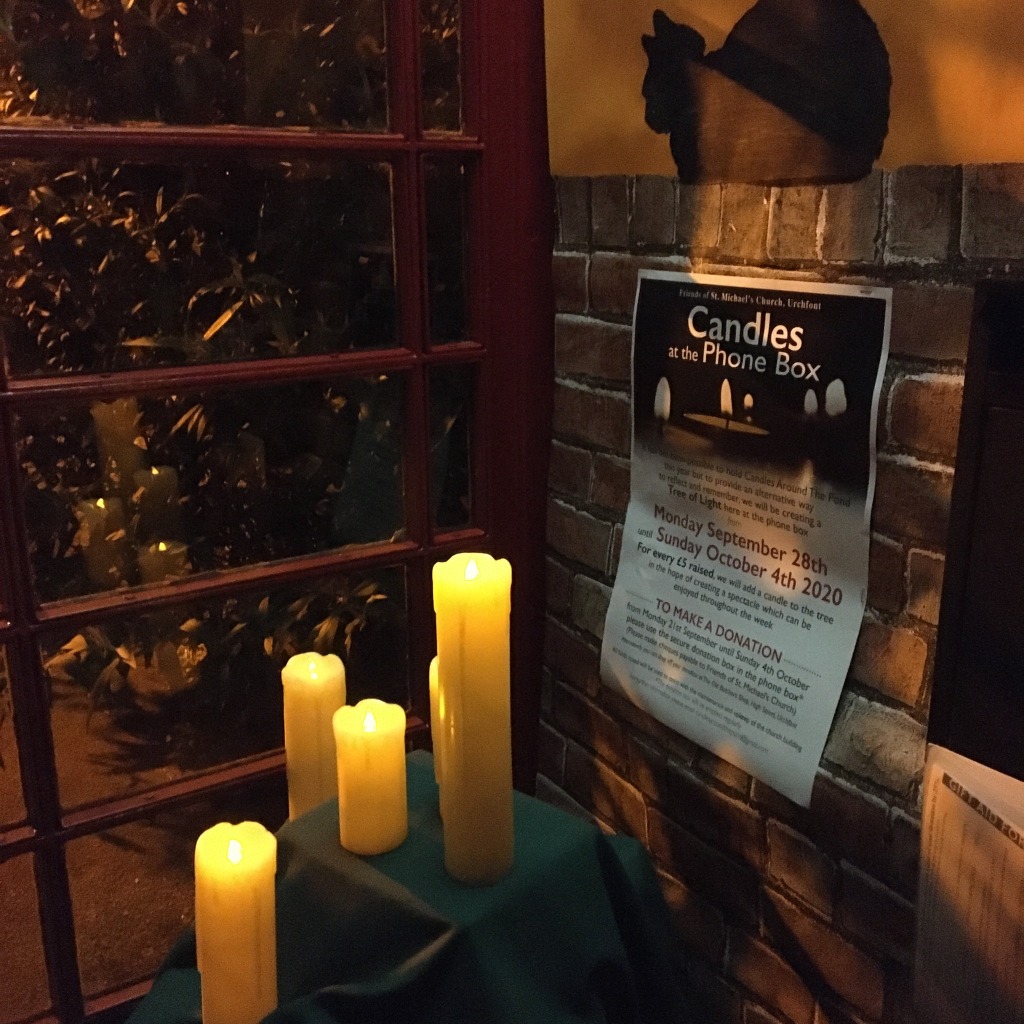
Nothing until these last few days, where the annual event “candles around the pond,” was reduced to “candles in the phonebox,” and raised funds for the church. And there was me thinking in Christianity the candle represents the light of God, and their ethics endorsed virtuous behaviour within its moral theology, as is their duty put in Leviticus 19:18 to love thy neighbour as thyself, and extend an unconditional hand of friendship that loves when not loved back, that gives without getting, and ever looks for what is best in others.

And here, their own children were rejected an art display as if they were suggesting a riot. To me, that is a sad reflection on today’s blinkered and hypocritic rural society and the very reason we need to openly discuss an issue most would wish to be eradicated many moons ago.