
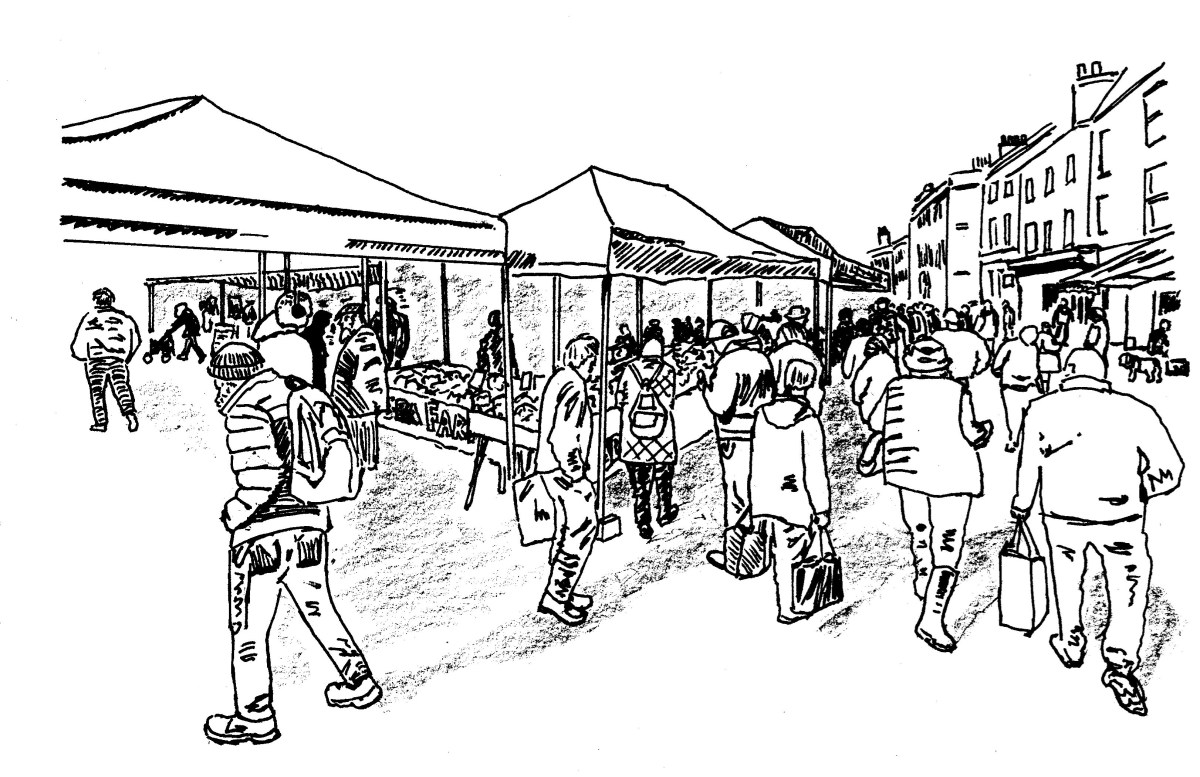
Sketches and Written by Brian Edwards
If not too distracted when bumping into townsfolk and village friends, you might remember to get more of a cheese you liked or that essential part for the vacuum cleaner…..
As regular readers of Devizine will know, one of the understated pleasures of Devizes is having a wander around on market days. From the listed buildings to the independent shops, our market day wanderings are significantly enhanced by the character of the town’s historic environment, and an enduring community spirit enriches the charming thoroughfares and myriad of routeways to and from the Market Place.
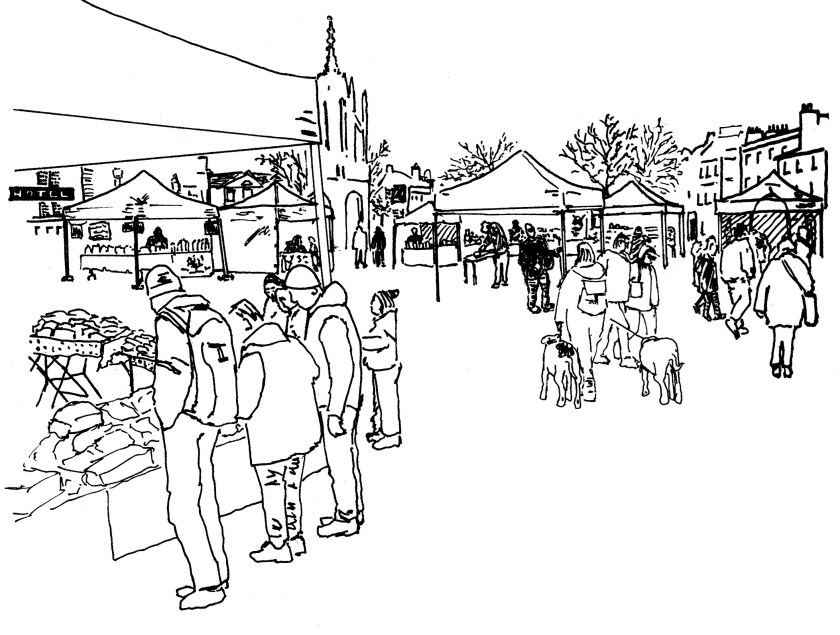
In 1724 the famous antiquary William Stukeley believed Devizes hosted ‘one of the best weekly markets in England’. In the previous century the Wiltshire born antiquary John Aubrey thought Devizes hosted the best fish market in Wiltshire, and in the early 16th century that father of English history, John Leland, stated the ‘market is very celebrate’. The town’s Thursday market dates to at least 1609, a regular potter around market stalls in Devizes dates to at least 1228 and around the stalls at fairs even earlier that century.
Hence, those visiting the Thursday market in the present are directly linking with a tradition that has periodically been celebrated as noteworthy and has survived hundreds of years of change. And because of this, your present day experience of the cultural footprint could prove influential.
A Town of Culture?
Having been ranked third among the country’s most quintessential market towns in 2025, Devizes is now bidding to become the U.K. Town of Culture 2028, which offers a top prize of £3 million as just one of a rollout of substantial financial awards. Towns must at this stage hope to have matched the relevant competition criteria to make the shortlist, which would elicit a £60,000 grant to support the development of a full application.
In addition to a famous flight of Georgian canal locks and a globally important collection in the Wiltshire Museum on Long Street, Devizes also has a reputation for a busy seasonal programme of festivals, markets and other social and educational events in addition to many places of worship, cultural hubs and active clubs. The lengthy list of cultural happenings covers anything from wildlife to nightlife and every experience from a punishing Westminster canoe race to tinsel tractor runs. The flip side is potentially overlooking something each of us does with regularity without ever thinking how rich and diverse it is in terms of a cultural experience.
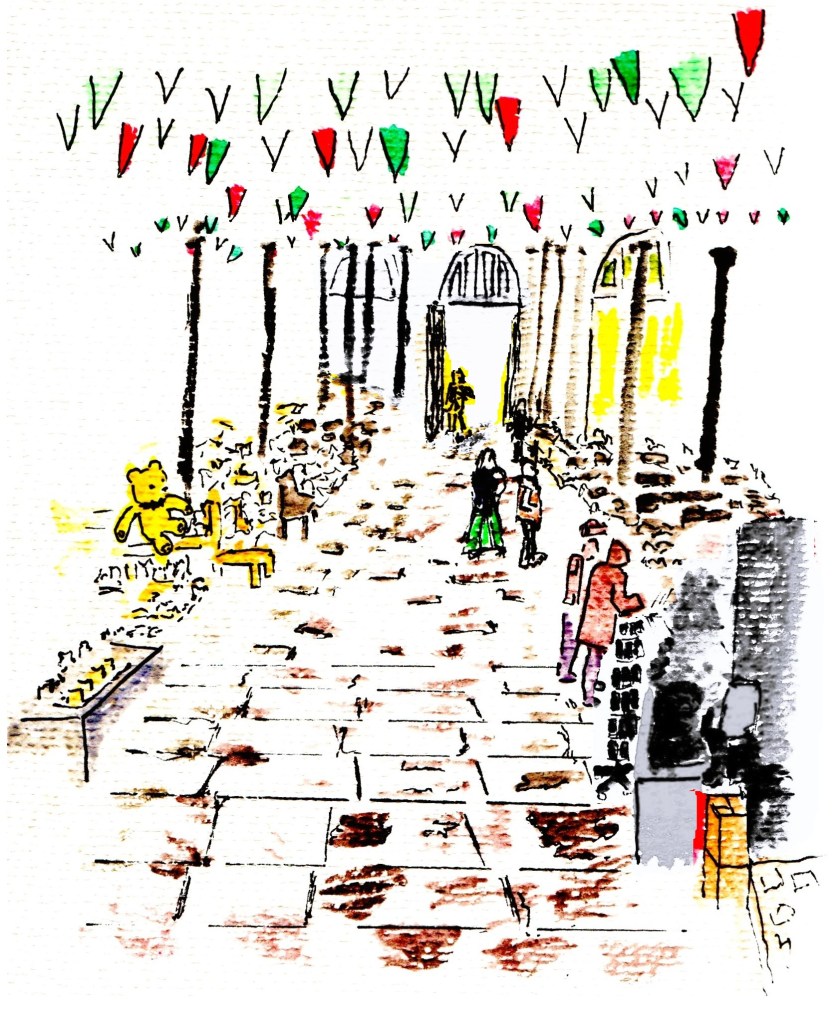
What might a Town of Culture look, sound and smell like?
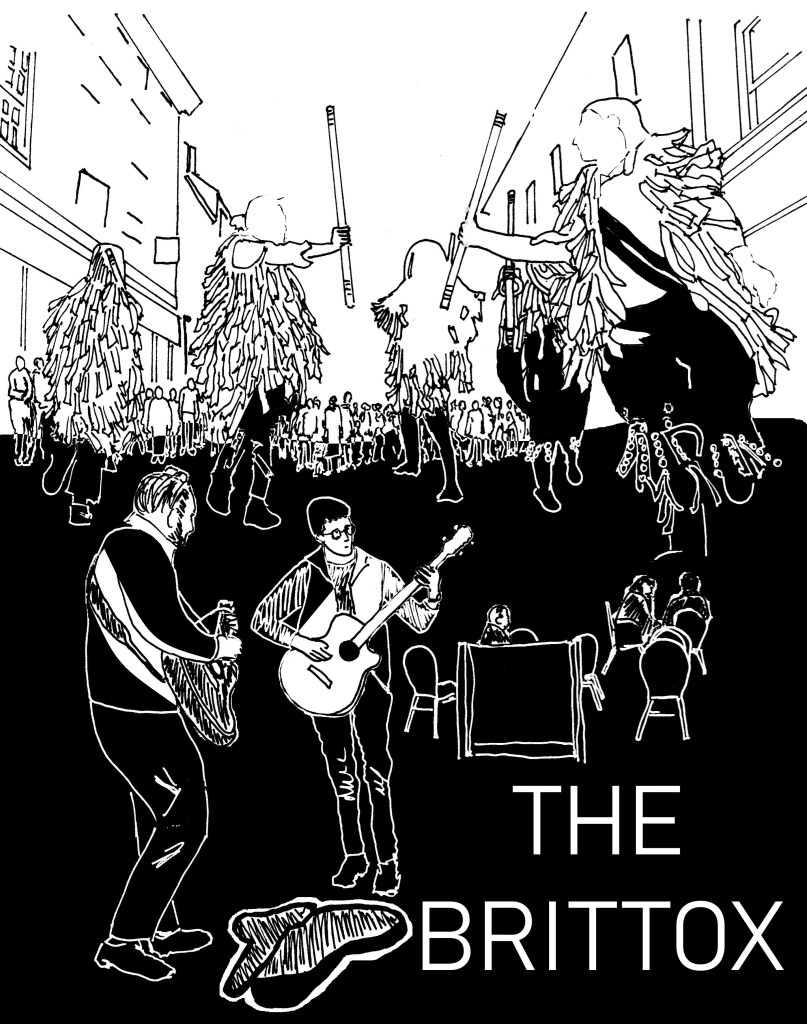
If you are familiar with the sights, sounds and smells of a market day mooch, then you may no longer notice the familiar market day hubbub: a soundtrack punctuated by the calls, banter and chats with market traders. You may not give a second thought to the welcome and directions you offered a newbie visitor. You will though notice the music, dance and drama brought by street entertainers, and the art that may be encountered in many forms from the stalls to the windows and interiors of independent shops.
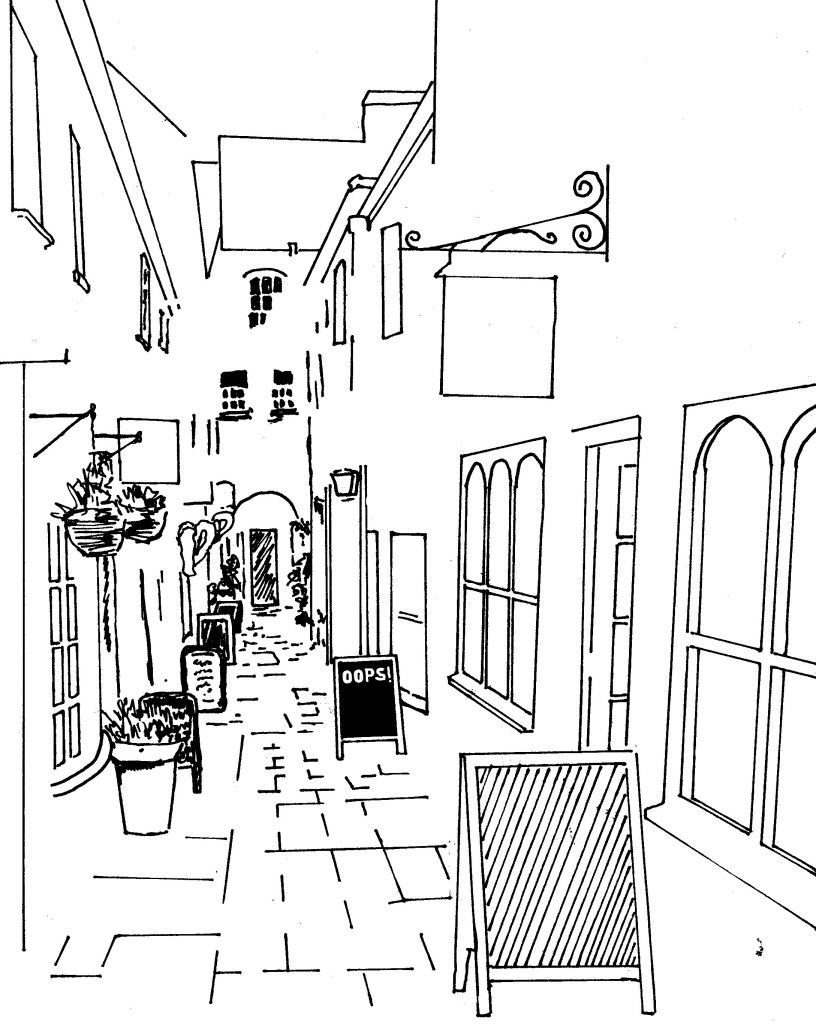
‘Tell us about the unique story and culture of your town.’
Few will have heard of the once legally renowned court case ‘The Mayor and Burgesses of Devizes v. Clark,’ that established the right of a jury to find a general verdict. The unique precedent from 1835 is possibly overlooked now and the butcher Jacob Clark of Maryport Street is entirely forgotten.
The gist of this court case was that Clark sold meat from his home on two successive Thursdays in 1833, when the Corporation held the right to charge butchers to sell to the public from their market stalls.
What interests us with the Town of Culture bid in mind, is not only that the Corporation established in law that their market and right to charge for stalls was ancient, but the arguments that were detailed about the civil authority customarily maintaining a safe adequate ‘known’ environment, where ‘large assemblages’ of the public can bear witness to transactions and events without travelling any great distance. It could have been written with the criteria set by the Town of Culture in mind.
The official Town of Culture requirements include a safe, supportive, non‑discriminatory environment accessible to all ages – a programme that reaches multiple audiences and offers opportunities for creative content – evidence of capacity, capability, and effective processes to deliver the programme successfully – strengthening or rejuvenating cultural and heritage infrastructure with realistic expectations. The history and modern day experience of the market in Devizes delivers all this and more.
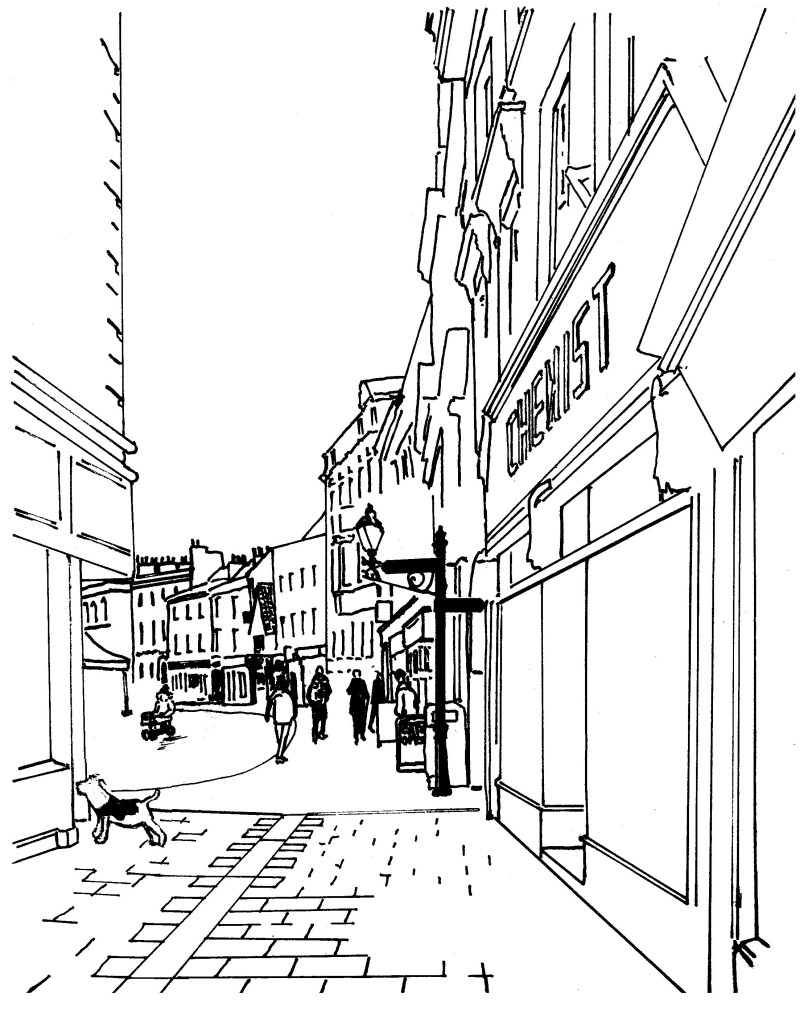
‘Culture is for Everyone’
We may never stop to think about it, but a magnificent cross section of local, regional and distant communities are represented on market days. From villagers to townsfolk and tourists threading their way around, to street performers, grassroots artists and other creatively active innovators; market days welcomes them all.
Every decade within living memory is represented on the town’s pavements, and anyone and everyone that isn’t housebound is unconsciously participating in a market day pageant. From prams and pushchairs to rollator walkers, wheelchairs and mobility scooters; these enabling wheeled wonders of our age are everywhere to be witnessed, as are many a responsible human with their pet dog on a lead.
Just sit on any bench in the Brittox and witness how many times you are lapped by elderly phone scrollers, middle age headphone wearers and teenage skateboarders. They are not all in their own world of course: a street performer recently remarked how young people engage with the informal music in the Brittox, stopping to listen and throwing coins into a hat or guitar case.
As outlandish as it may seem then, your wanderings on a Thursday could bear witness to an experience that ticks all the criteria boxes to underpin a bid to become the U.K. Town of Culture 2028. There is surely nothing that is more inclusive, culturally rich and diverse in our lives than a weekly market day dawdle in Devizes. This cultural experience is for everyone from their pram to their very last leg and it is entirely free at the point of delivery.
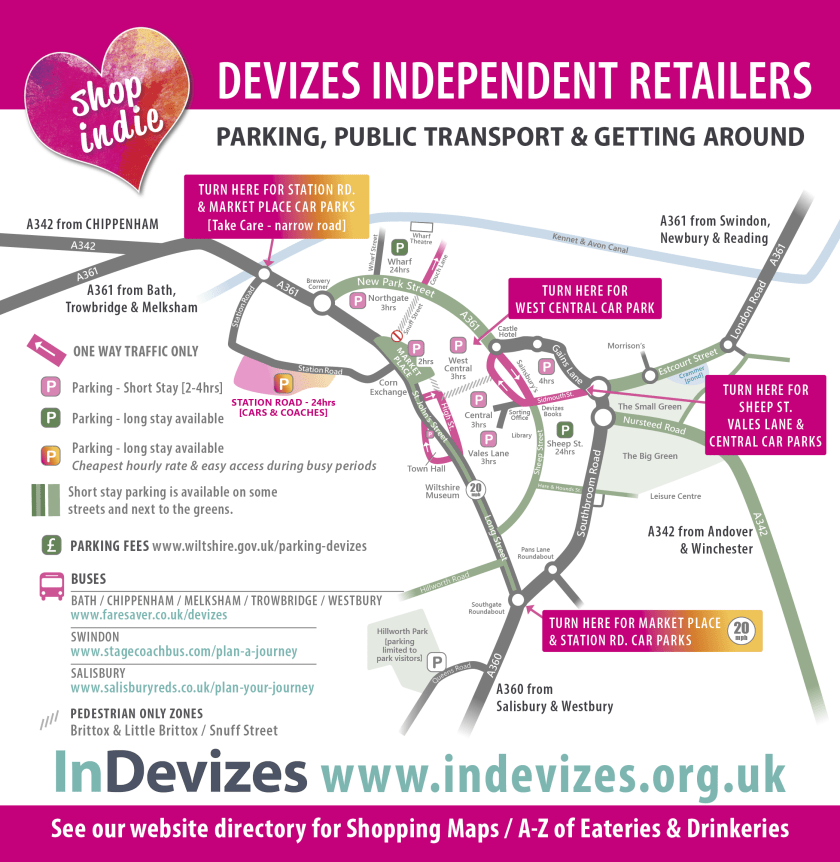
Acknowledgements
Many thanks to our friends ‘shop indie InDevizes’ for both the excellent map and much encouragement https://www.indevizes.org.uk/
Many thanks also to David Dawson, Devizes Jubilee Morris and Daddy Longlegs for their assistance. Many thanks also to all the wonderful dogs and humans that featured in doodles which were redrawn and moved around to work up the final sketches.
Brian Edwards is a Visiting Research Fellow at The Regional History Centre, UWE Bristol.






Captain Accident’s Sayonara Paranoia
After five years, a new album drops tomorrow (Friday 23rd October) from southwest Welsh reggae outfit, Captain Accident & the Disasters, and it’s worth the…
Keep reading
Cephid; Electronic Music Producer and Town Crier Partnership in Devizes
Well, what else is there to oyez about? Congratulations must go to our Devizes Town Crier, Charlotte Howard-Macdonald, again today, as Brian Mathew MP tabled…
Keep reading
Devizes; a Place for Festival, or Negativity?
On the Festival of Discovery, other political discoveries, and is the Crammer full yet?! No to the latter, but local Facebook groups are full ….of…
Keep reading
“Shakespeare’s Green-Eyed Monster” on tour, Central Wiltshire October 17th-24th 2026.
by Ian Diddamsimages by Gill Morrell and Penny Clegg How all the other passions fleet to air,As doubtful thoughts and rash embraceddespair, And shudd’ring fear, and green-eyed jealousy- Merchant of Venice, Act 3 Scene 2, William Shakespeare O, beware, my lord, of…
Keep reading
Shrek at Mac’s Theatre School
“What are you doing in my swamp?!” Shrek asked a horde of fairytale creatures, exiled to his wood by Lord Farquaad in his namesake Dreamworks…
Keep reading
Devizine Launchpad on Sunday
Okay you lovely lot, who are deffo coming The Festival of Discovery this weekend across Devizes, and who, deffo, going to pay us a visit…
Keep reading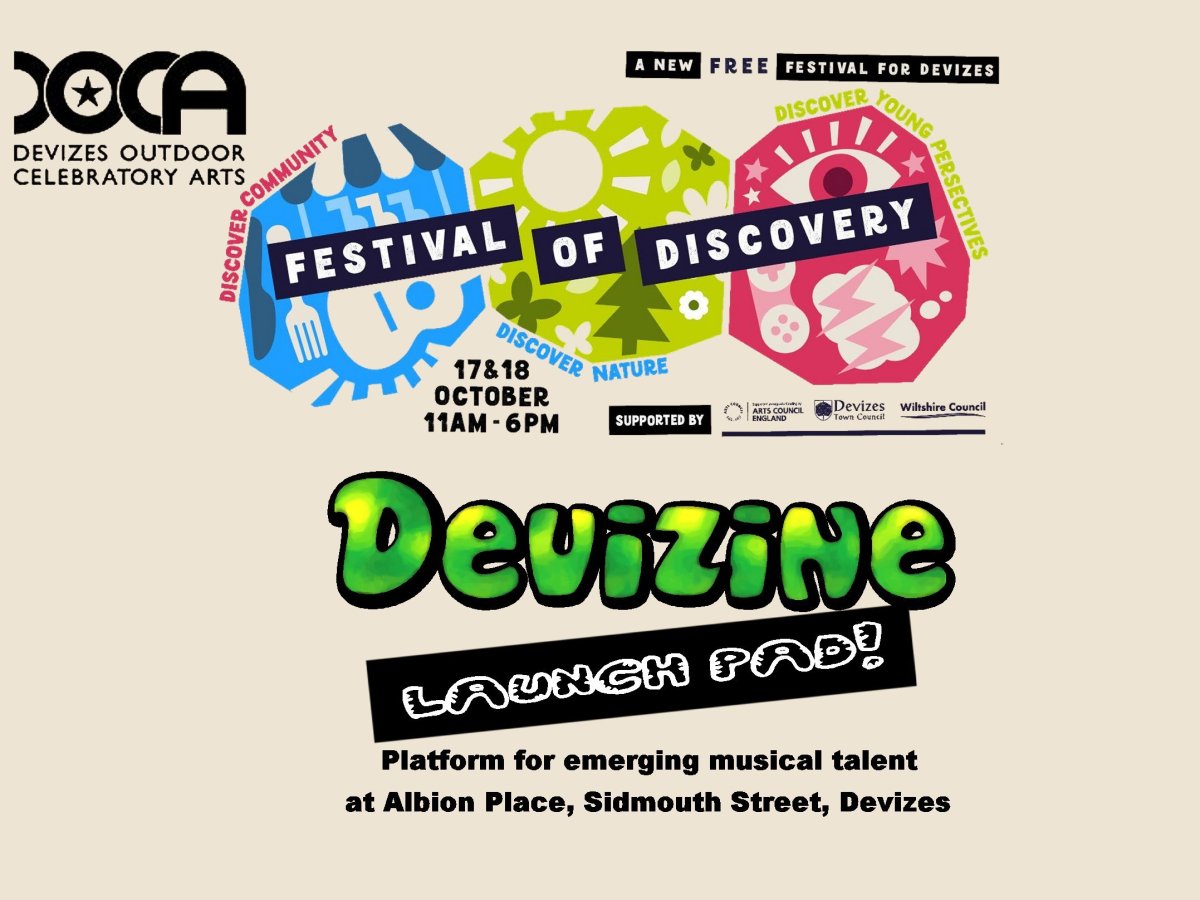
Devizine Launchpad at DOCA’s Festival of Discovery
So, you’re joining us at Albion Place on Sidmouth Street in Devizes this weekend, right?! Don’t say I’ve not told you about it once it’s…
Keep reading
Delaying the Inevitable with Lou Trigg
Wowzers, it was four years ago since we last mentioned local singer-songwriter and musician Lou Trigg, when we reviewed her single to come out of…
Keep reading
What I’ve Been Missing, a New Talk in Code Single
What’s that? What have we been missing? Well, it’s been a while since the last Talk in Code single, and there’s one coming our way…
Keep reading
Devizes Retailers Unite and Wiltshire Council Revise Roadwork Plans
People power in Devizes! Due to pressure from Devizes retailers and councillors, Wiltshire Council today revised their plans for essential cable works in Devizes, originally…
Keep readingSomething went wrong. Please refresh the page and/or try again.


Great article and a lot of work, congrats, Eddy Land
LikeLike