
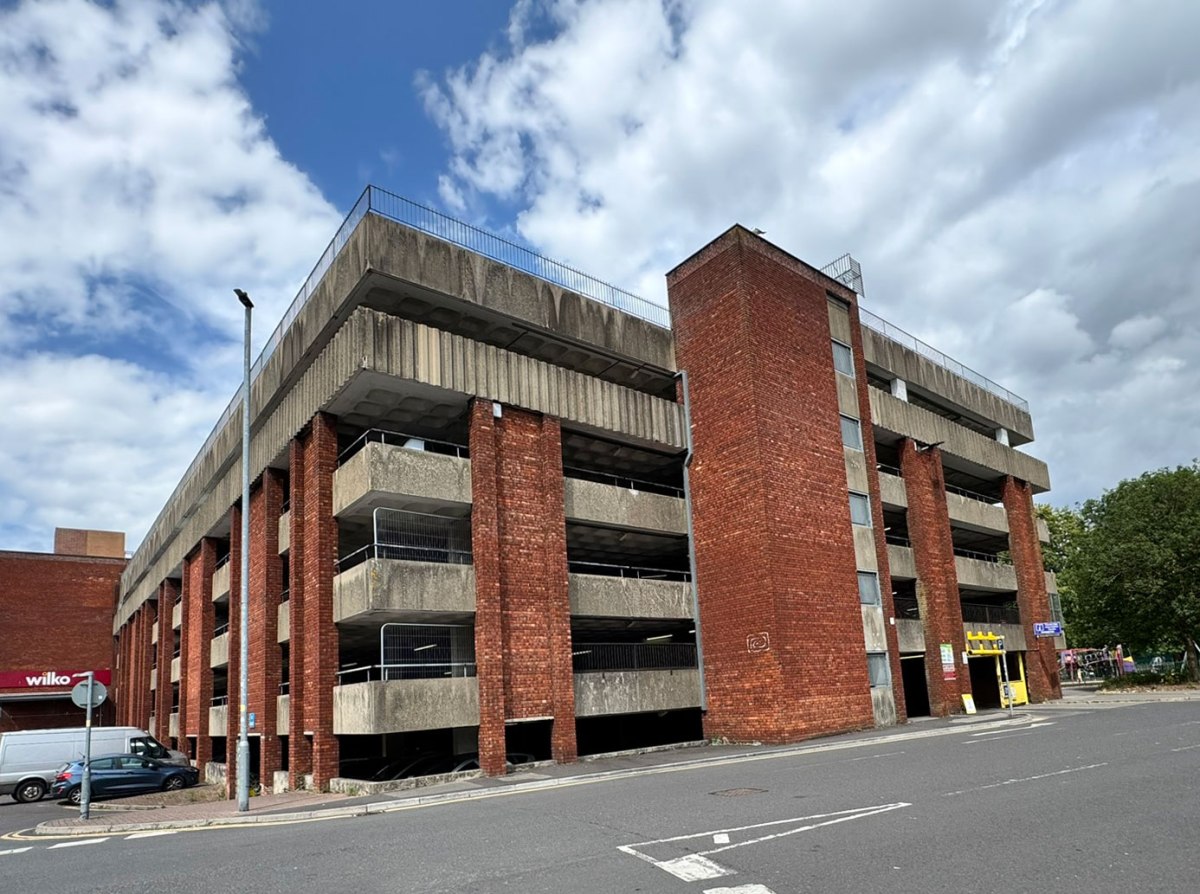
“It’s not all that glitter is gold,” Bob Marley sung, “half the story has never been told.” Okay, he was referring to 400 years of institutionalised slave trading on an international and industrial scale, whereas we’re on about a Trowbridge multistorey carpark…..
And anyway, the story is there for all to see; Wiltshire Council meetings are videoed and published on YouTube. If you’ve not the time to lodge two matchsticks into your eyes and strain for an epic four hours, you might rely on wonky social media opinion, where I’d favour it’s not really about a carpark, rather political point-scoring from some still bitter that they lost their control of County Hall.
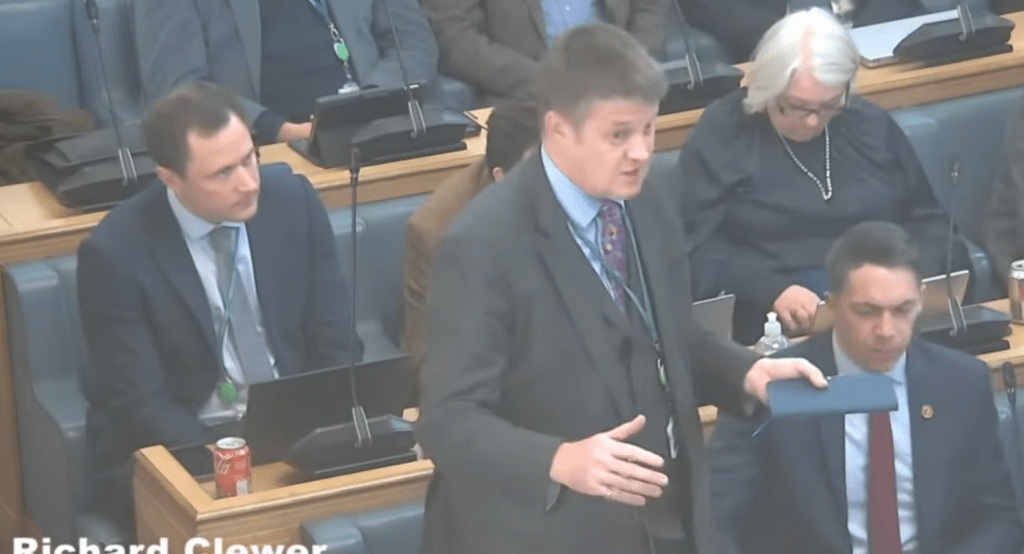
If we were positively peddling towards fresh notions from a LibDem headed Wiltshire Council, a full council meeting on Tuesday 7th January jabbed a stick into the spokes. Despite both Conservatives and Reform nationally criticising each other, when they locally gang up they can sway the vote. The meeting took on two major issues, the first was increasing council tax on second homes, where Conservative and Reform councillors voted against, and, in his oversized suit, ex-Wiltshire Council leader Richard Clewer contemptuously scoffed at the poor on a Marie Antoinette level.
Using the analogy, “if you’ve got one car, and you buy another, should you pay extra tax because you’ve got two cars?” Councillor Clewer arrogantly justified voting it down. Not in a financially stable economy, no, but our reality differs, and who’s fault is that?!
If you want a car analogy, Richard, try this sucker for size; “if I buy a car from a mate I thought was trustworthy, and it broke down three miles down the road, should he pay for the repair?!” Fourteen years of Conservative austerity focussed entirely on the working class; they did this, they caused the deficit, and refuse to contribute to fix it.
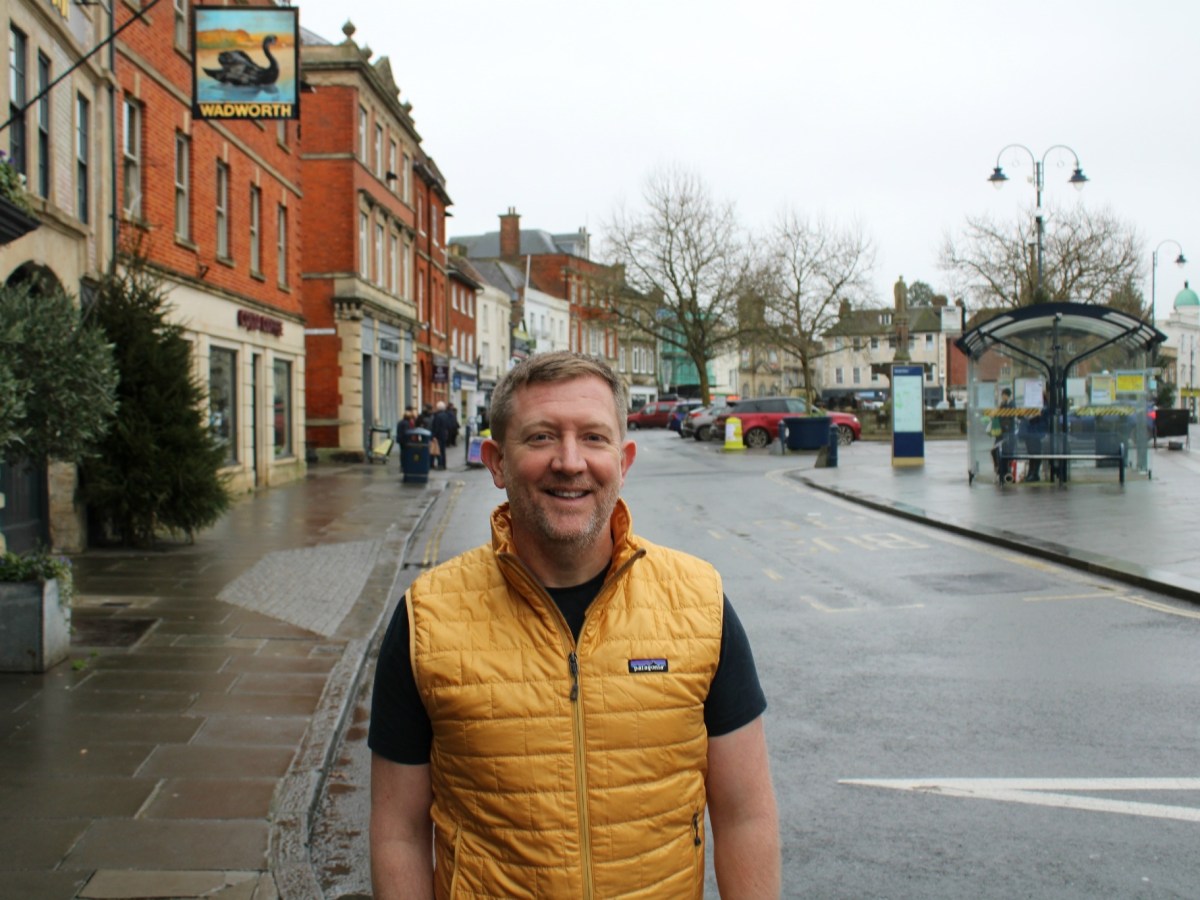
Taylor Wright, Wiltshire Councillor for Devizes East called the meeting “a deeply disappointing moment for Wiltshire.” I love this guy- not like that, you filthy sort; he’s a young family man with fresh ideas of equality! In voting it down, Taylor stated, “they chose to prioritise, in their own words, ‘the 0.5% of households’ in Wiltshire who can afford a second property over the needs of the remaining 99.5% of residents.”
Taylor mentioned struggling families, the cost of living, “young people locked out of the housing market,” and “communities crying out for investment in services,” hailing the decision swayed by this Conservative and Reform swarming “a missed opportunity to make a small but meaningful step towards fairness.” Tempting me to originally concentrate on this issue rather than the second major issue raised, the future of a dilapidating Trowbridge carpark, because that felt like a storm in a teacup, I needed a bath, and what’s that got do with Devizes anyway?!
Cue Devizes town councillor and ex-Wiltshire one, Iain Wallis, who posted on his dubiously bias Facebook group Devizes Issues that “Lib Dem administration plan to gift a developer and carpark and £2.5m of our money defeated,” in glorious jubilation. In it he stated “this overturns the cabinet’s wishes which were largely discussed in secret and once again prioritises us in the rest of Wiltshire rather than subsiding Trowbridge.”
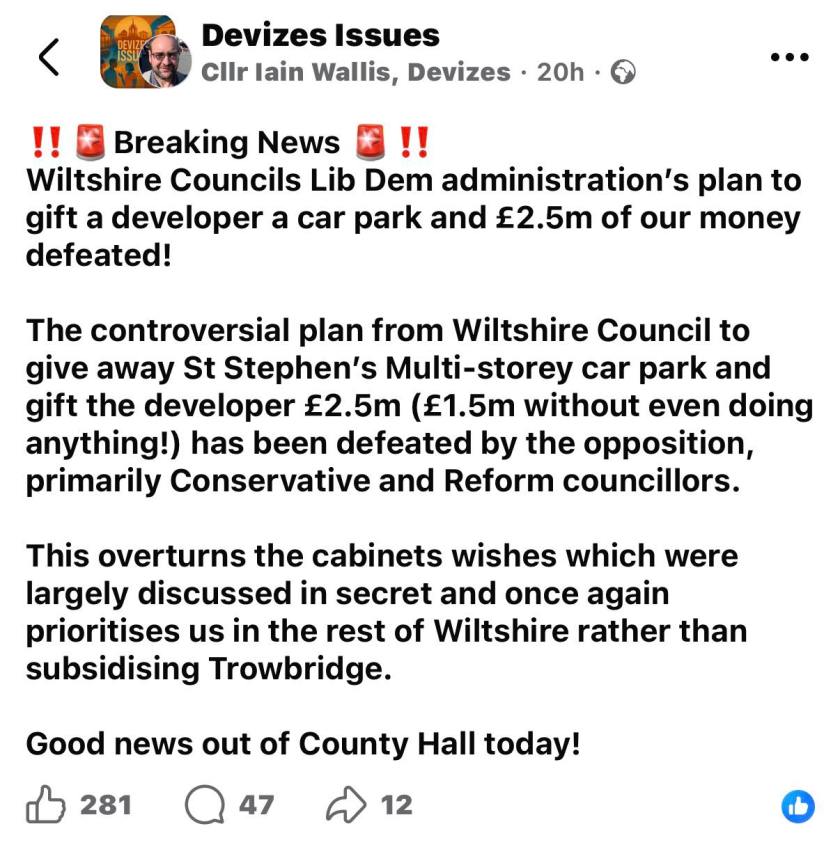
While deliberately newspeak, it’s not entirely false, save it being far from a “gift,” and I don’t get how it was all secret if videos are published, but again, Taylor Wright explained “plainly” why he voted in favour of disposing of the asset, even though, he said, “I know the headline figure of £2.5 million sounds shocking at first glance.” Through this source we see how misleading Mr Wallis’s post is; bearing in mind he lost his county council seat, it’s a shame there’s a bitterness projected in his tone, persuading him to miss half the story.
“The car park itself is in serious disrepair. Independent assessments show that within the next ten years it is highly likely to require full demolition and rebuild. The estimated cost of that work is up to £8 million,” Taylor fills in the gaps. “If Wiltshire Council keeps the car park, that £8 million bill will fall on all Wiltshire taxpayers – including residents in Devizes, who gain no benefit from free parking in Trowbridge.”
So yeah, the price tag to solve this might be £2.5m, but the option suggested by the Cons and Reform would be significantly higher, something Mr Wallis omitted from his post. I think a chat with Taylor is as overdue as my bath……
Our chat didn’t dwell on Mr Wallis’s post, it only serves to illustrate how bending the truth to suit a narrative is misleading. I wanted to discover the options presented to the councillors, and why some favoured dishing out £8million of taxpayer’s dosh to save a dysfunctional and dilapidated carpark. “I cannot believe it’s as controversial as it is,” Taylor agreed, and with a heavy sigh explained how Iain had posted again, accusing him of lying.
I put this concept to Taylor, that rather than it being about a carpark, it was bitterness or even a punishment for the change in control of the council. “Yeah, there’s a lot of that,” he concurred. You may recall a day when St Stephen’s free carpark fed into a busy shopping centre, but that era is sadly all gone. “Because of a legal covenant tied to the shopping centre, parking must remain free. That means the site cannot generate any income, now or in the future, no matter who owns it,” Taylor explained.
“it’s dilapidated,” he said, “so the benefits of having free parking for it are slim. I think people are frustrated, in Trowbridge specifically, of the ability to park free, but that doesn’t benefit anyone in Devizes, unless you occasionally visit Trowbridge, but it shouldn’t come from our council tax. Calne has free parking, but the town council pay that, as do other town’s councils pay for their parking, so if Trowbridge are willing to pay to continue that is beside the point. It’s Trowbridge paying for Trowbridge, and I don’t have a problem with that.”
“But my logic on paying the £2.5 million to dispose of that asset, I understand the headline ‘Councillors Giving half a million and a carpark to a developer’ sounds horrendous, but when look into the detail, which I don’t believe some of my Conservative colleagues have, they’ve heard Lib Dems are proposing something, let’s oppose it; the building is coming down, it’s crumbling, we’re doing patchwork jobs, including one for half a million recently to try to keep it going for a few more years and for safety concerns, but we need to get rid of this asset, because it’s not an asset, it’s a major liability. Commercial properties can have a negative value, in this case it’s been assessed independently, and it has negative value because of the liability. The only value it has to anyone would be the owner of the other half of the covenant, which is the shop centre owner.”
“There are other options,” Taylor expressed, “but not good ones. The other would be to fully develop the site at a cost, estimated to be in the region of £8 million. I’m not suggesting the Conservatives are pushing for that, but if the building gets to a point where it’s so dilapidated we’re instructed to rebuild it, which we could be, that will be the cost. The other option is to find another developer to take on the site and pay us, but they’d be paying us for a site which is falling apart and in need of a rebuild, and by law cannot make any money. So, why anyone would buy it from us…commercially it makes no sense.”
On the idea of the council buying the site despite it’s negative value , Taylor explained, “we did explore the possibility of changeling the convent in court, but were given a 60% chance of success and a highly placed judge in this field recommended we don’t do this, because if we lose the shopping centre owner could counteract us, claiming because it’s in such a shoddy state, we do need to completely rebuild it. So, whilst the initial cost for the legal action might be low, what follows from it could be extremely expensive, and us being immediately forced to demolish and rebuild the carpark, hence we saw that option as too high risk.”
So, once the free parking scheme was an asset, and we all thought we were parking for free, now whimpering it’s unfair for one town to have free parking when others don’t seems superfluous; it’s a burden or curse, we’re paying for in the end. The issue only remaining is how to solve it cost effectively; an issue not caused by the new council, but one they inherited. Leaving me confused still as to the opposition to demolish it.
“It was their business to pursue the other two options,” Taylor explained, “they wanted to seek other developers who might be interested in purchasing the property, but as I said, they’re going to come with the same caveats, the covenant prevents it making money, and it needs to be rebuilt, so the idea of another developer paying us for something which is a liability is laughable from a commercial sense. They might find a another developer who will take it for the £2.5 million contribution to redevelopment, but again, they’ll still be subject to the covenant so we’d be paying for it to be redeveloped for a developer who’s not going to make any money from it. So, again, it doesn’t make commercial sense, but the large proportion of conservative councillors were looking at challenging it in court, and yes, it’s possible it could win, but is unlikely. And also, if we lose we face our costs and the other side’s too, and, potentially, accountancy on the basis of dilapidation and having to rebuild the whole thing immediately. All options are risky. As much as £2.5 million is a huge amount, and I take no pleasure in signing off on spending it, for this purpose I think it’s a terrible way to spend money, but, at least to my mind, we don’t have any other sensible option.”
Not to end this on a sour note, I did joke the Reform councillors probably wanted to keep it to hang flags off of, and Taylor expressed the opinion of one, Chris Brautigam, who has been “really pushing to hold onto the site, as he’s a Trowbridge councillor, and I can understand his reasoning. It’s based on wanting to keep the carpark free for the residents of Trowbridge, which is a valid objective, and one of the most respectable reasons to want to hold onto it; he’s doing it for his residents, and has campaigned hard and respectfully for that, and I congratulate him, but I don’t think it’s the right move, for my residents.”
How what seemed like an open and shut case became such a major issue is concerning evidence petty bitterness and political point-scoring is consuming the council, where time could be better spent on solving issues. “We were floored when this became controversial,” Taylor said, “we’d a pre-meeting, where this was one where we said this will be fine, it’s obvious this is right path, and there was no way to disagree with it. There might be a couple of Trowbridge councillors who might disagree, but all in, it’s probably go through quite easily. And then, all of a sudden, Armageddon kicked off! It took us all by surprise.”
It all left me pondering more generally, on if the objections was driven by traditionalism, that there was hope high street shopping would return in a trend rebelling from internet shopping. “There was an option to buy the shopping centre,” Taylor revealed, “which as we’ve seen with other councils up and down the country,” and he exampled his hometown of Woking, who’s council purchased the shopping centre and “are now in a billion pounds worth of debt over the building costs and lack of revenue it generates. I don’t think councils have an business owning shopping centres.”
The biting reality is that all towns are unfortunately losing shops, but if you visit a town like Devizes, where many will complain we’re losing shops, it’s still relatively busy because the trend has changed and we adopt now a café culture where visiting town is a treat; you buy a light lunch or coffee, and browse, less everyday functionally for goods, but more ascetically, and a crumbling seventies Bauhaus carpark, once functional, is not ascetically pleasing, perhaps more an eyesore, and discouraging people to visit.
I thank Taylor Wright for his time, and enlightening us. It’s best to take social media posts with a pinch of salt, especially when they come with political bias; it’s been reported comments with opinions differing from that given by the admin on the aforementioned Devizes Issues one, have been deleted and persons have faced being banned from the group. We always must dig a little deeper to find the truth.
Can I get in the bath now?!


















































































 devizine.com